



A call with David Mitroff, Ph.D.
Talk through your business with David
Quick answer
LinkedIn is not a resume site, and it does not reward pitching. It rewards owners who connect generously, post consistently, invite people to things and move the conversation to coffee or a call. Used that way, LinkedIn is a list of the people you want to meet, and a way to stay in front of them. Piedmont Avenue Consulting, Inc. plans LinkedIn and relationship marketing with owners across the San Francisco Bay Area, Los Angeles, Orange County and New York.
Key takeaways
- LinkedIn is a searchable list of the people you want to meet, filtered by location, title, industry and mutual connections.
- A bare connection request usually gets accepted, while a pitch attached to one is the fastest way to get ignored.
- A LinkedIn post works twice, once when it goes out and again months later when someone finds it through search.
- LinkedIn works best around in-person meetings, such as connecting with registrants before an event and suggesting coffee afterward.
LinkedIn myths keep many owners from using one of the most useful tools they already have. At Piedmont Avenue Consulting, Inc., we are a business and marketing consulting firm that works with owners in the San Francisco Bay Area, Los Angeles, Orange County and New York to start, grow and scale their businesses. David Mitroff, Ph.D., has used LinkedIn for years to find panelists, invite executives, break into new industries and keep in touch with the people he meets at events. Most of what owners believe about the platform points them the wrong way.
Myth: “LinkedIn is just for job seekers”
Fact: LinkedIn is a searchable list of the people you want to meet.
In The 45 Day Consultant, David describes LinkedIn as a living database of professionals, filtered by location, title, industry and mutual connections. An owner can use it to find new partners, reconnect with past colleagues and clients, stay visible with regular posts and message new connections with context and value.
That makes it a tool for a restaurant owner looking for corporate catering clients, a contractor looking for architects, an attorney looking for referral partners and a consultant looking for the next industry to serve. None of them is looking for a job.
Myth: “You need a premium account to get results”
Fact: the value comes from how you use LinkedIn, not what you pay for it.
In the book, David writes that he has developed strategic partnerships, secured speaking invitations and gained new clients through LinkedIn, and that whether or not you pay for premium services, the value comes from building relationships, sharing insights and staying visible to your network. Start with a complete profile, a clear headline and a photo that looks like you today. Pay for more only when you know what you would use it for.
What a strong profile includes
“Build out your LinkedIn profile and engage with your network by sharing relevant insights or examples of your work.”
David Mitroff, Ph.D., in The 45 Day Consultant, Chapter 26: Selling Without Selling
- A headline that names who you serve and what you do, not only your title.
- A current photo, clear and friendly, where you look the way you will look when you walk into a meeting.
- A short summary in your own voice, with the problem you solve, the people you solve it for and how to reach you.
- Your experience, written as results and responsibilities, not only job titles.
- Examples of your work, such as an article, a case study shared with permission or photos from an event you hosted.
- A clear next step, such as a link to book a call or to register for your next event.
“Add one line to your email signature or LinkedIn profile inviting people to your next event or open office hours.”
David Mitroff, Ph.D., in The Event Effect, Chapter 1: Invite, Don’t Sell
That one line turns a profile from a résumé into an invitation. Our guide on building a personal brand as a business owner covers how the profile fits with the rest of how people see you.
Headlines for five kinds of owners
- A restaurant owner: Owner of a neighborhood Italian restaurant, hosting private dinners and corporate events.
- A general contractor: General contractor for kitchens, additions and tenant improvements across [your county].
- An attorney: Estate planning attorney for families and small business owners.
- A dentist: Family dentist, caring for patients of every age in [your town].
- A consultant: Business consultant to owners who are ready for a second location.
Each one tells a stranger who you serve and what you do, in one line. Our step-by-step guide on how to describe what you do works through the sentence behind it.
Myth: “A connection request needs a pitch”
Fact: a bare connection request gets accepted. A pitch gets ignored.
When David wants to break into a new market, he picks a target narrow enough to act on, such as an industry or a city, and connects with everybody in that world, plus the people who sell to them.
“A pitch attached to a connection request is the fastest way to get ignored.”
David Mitroff, Ph.D., in The Event Effect, Chapter 9: Your Invitation List
A request with no message costs the other person nothing, and most people accept. The relationship starts later, with an invitation or a useful note, not with a sales message on day one. Our guide on how to break into a new city or market shows the rest of the approach.
Messages that work, and messages that do not
Once someone accepts, the first message sets the tone for everything after it.
- Instead of a paragraph about your services and a link to your calendar, try a short thank-you for connecting and one question about their work.
- Instead of “I’d love to pick your brain,” try an invitation to something specific, such as a panel, a dinner or open office hours, with the date and the topic.
- Instead of a copied message sent to a hundred people, try a note that mentions where you met or a post of theirs you read.
- Instead of a follow-up every few days, try one useful note a month later, such as an article they would like or an introduction.
The best messages read like a note from one person to another. Our guide on selling without selling explains why asking beats pitching.
Myth: “Only connect with people you already know”
Fact: your connections are part of your invitation list.
In The Event Effect, David lists LinkedIn connections among the people who belong on an owner’s invitation list, along with everyone who registers for an event and everyone you meet at one.
“Accept generously, and keep in touch.”
David Mitroff, Ph.D., in The Event Effect, Chapter 9: Your Invitation List
A connection you accepted this year is someone you can invite to your next breakfast, panel or open office hour. Keep a note of how you know each person. Months from now, where you met will matter more than any title.
“Connect with five people from it on LinkedIn this week, and invite them to your next event.”
David Mitroff, Ph.D., in The Event Effect, Chapter 3: How Leaders Create Luck
In the book, the step starts with picking one industry or group you would like to know better. It works because it pairs two small actions: a connection, then an invitation. Neither one asks for anything.
Connections that don’t turn into meetings?
Schedule a call with David Mitroff, Ph.D. We look at how you use LinkedIn now, and how to turn it into introductions.
Or call David at 510-761-5895, 8 AM to 8 PM, seven days a week.
Myth: “A LinkedIn post is gone in a day”
Fact: a post works twice, once when it goes out and again when someone finds it later.
“A single LinkedIn post can be seen instantly (active), and months later via search (passive).”
David Mitroff, Ph.D., in The 45 Day Consultant, Chapter 6: How to Attract Customers
“Every post is a seed.”
David Mitroff, Ph.D., in The 45 Day Consultant, Chapter 6: How to Attract Customers
Some posts bring a message the same day. Others sit quietly until the right person sees them months later. When that person finally books a call, they feel as if they already know you. David saw this when he began writing about yachts and posting the articles on his website and LinkedIn, and the owner of the largest yacht brokerage in Northern California called and hired him as a consultant. Our story on how writing about yachts brought in a client tells it.
Post consistently: insights, client stories with permission, the events you host and the people you want to thank. Our comparison of active vs. passive marketing explains why both kinds of results matter.
Myth: “LinkedIn replaces meeting people in person”
Fact: LinkedIn is how you set up the meeting and keep it going afterward.
The best use of LinkedIn starts or ends somewhere else. Before an event, David looks up the people who registered and connects with them, so he already knows a few faces when he walks in. After an event, he connects with the people he met the same day, then follows up with a short note suggesting coffee. And he finds most of the panelists for his events on LinkedIn, with a short note like the one he shares in The Event Effect:
Hi [Name], I’m organizing a “Meet the Founders” evening on [topic] on [date] from 6 to 8 p.m. at [venue], and I’d love to have you on our panel of experts. Let me know and I’ll tell you more.
One clear ask, with the topic, the date and the time. Nothing to buy.
The platform has led David to rooms of its own. In The 45 Day Consultant, he writes that Jeffrey Gitomer, the bestselling author of The Little Red Book of Selling, connected with him on LinkedIn and invited him to a small, exclusive dinner. And someone he met at a business event in San Francisco, who did not need consulting, added him on LinkedIn and months later introduced him to a sister-in-law who owned a restaurant group.
“The seeds you plant today may bloom when you least expect.”
David Mitroff, Ph.D., in The 45 Day Consultant, Chapter 6: How to Attract Customers
Our guide on why to ask for introductions, not referrals shows how to make those introductions easy.
A weekly LinkedIn routine
LinkedIn rewards steady habits more than bursts of effort. A simple weekly rhythm keeps you visible without taking over your calendar:
- Monday: connect with everyone you met last week, with no pitch attached.
- Tuesday: connect with five people in the industry or city you are building in.
- Wednesday: post one useful idea, a client lesson shared with permission or a photo from an event.
- Thursday: reply to every comment and message, and comment thoughtfully on three posts from people you want to know.
- Friday: send one note suggesting coffee, and one invitation to your next event.
Keep a list of who you connected with, where you met and what you talked about. Our follow-up system shows how to keep that list working between meetings.
How LinkedIn fits each kind of business
- A restaurant or caterer: connect with office managers, event planners and the people who book team dinners, then invite them to a tasting.
- A contractor: connect with architects, engineers, property managers and the vendors who sell to them, and post photos of finished work.
- An attorney or accountant: connect with the other advisors who serve the same clients, and post plain answers to the questions clients ask every year.
- A consultant: pick one industry at a time, connect with everybody in it and write about what you learn.
- A shop or studio: connect with neighboring owners and local organizers, and invite them to open office hours or a small event.
Common LinkedIn mistakes
- A headline with only a job title, so a stranger cannot tell who you serve.
- An old photo, or no photo at all.
- A pitch in the first message, before any relationship exists.
- Posting in bursts, then going quiet for months.
- Connecting at an event and not writing afterward, so the new connection forgets where you met.
- Treating LinkedIn as the whole plan, instead of the bridge to a coffee, a call or an event.
How to tell whether LinkedIn is working
“The tools keep changing; the principle doesn’t.”
David Mitroff, Ph.D., in The Event Effect, Chapter 10: Promotion That Feels Like an Invitation
Followers and likes are easy to count and easy to misread. Track what leads to business instead:
- Conversations started, in messages or comments.
- Coffees and calls booked from a LinkedIn connection.
- Event registrations that came through a LinkedIn post or message.
- Introductions a connection made for you.
- Clients who first found or remembered you on LinkedIn.
Ask every new client how they found you, and write down the answer. After a few months, the pattern shows which posts, industries and habits bring in the work.
A first month on LinkedIn
If you are starting from a quiet profile, give yourself four weeks:
- Week one: rewrite the headline and summary, add a current photo and add one line inviting people to your next event.
- Week two: connect with everyone you have met in the last year, from clients and partners to the people at your last networking event.
- Week three: pick one industry or city, connect with five people in it and post your first useful idea.
- Week four: invite your new connections to something specific, and suggest coffee to the three conversations that went furthest.
By the end of the month, LinkedIn is no longer a profile you forgot about. It is a short list of people who know your name, and a few coffees on the calendar.
A fifteen-minute LinkedIn tune-up
- Update your headline so a stranger knows in one line who you serve and what you do.
- Add a current photo and a short summary in your own voice.
- Pick one industry or city you want to know better, and connect with ten people in it, with no pitch.
- Connect with everyone you met at your last event, and send one of them a note suggesting coffee.
- Post one useful idea this week: a lesson from a client, a photo from an event or an invitation.
- Invite your connections to your next event, one personal message at a time.

How we work with owners on LinkedIn
We look at your profile, choose the industries and cities worth building in, plan the posts and articles that keep you visible and connect LinkedIn to the events, introductions and follow-up that turn connections into clients. In the first ninety days of working together, our job is to find our fee, which means making or saving you more than you pay us. We start with an initial consultation and a paid assessment, then build a ninety-day plan and a twelve-month marketing calendar. Learn more about our business consulting services.
From David’s books

The 45 Day Consultant Field Guide
This is also in David’s book, in Chapter 13, “Make Your Name Mean Something”. Each chapter page sums up the idea, the story behind it and what to do next.
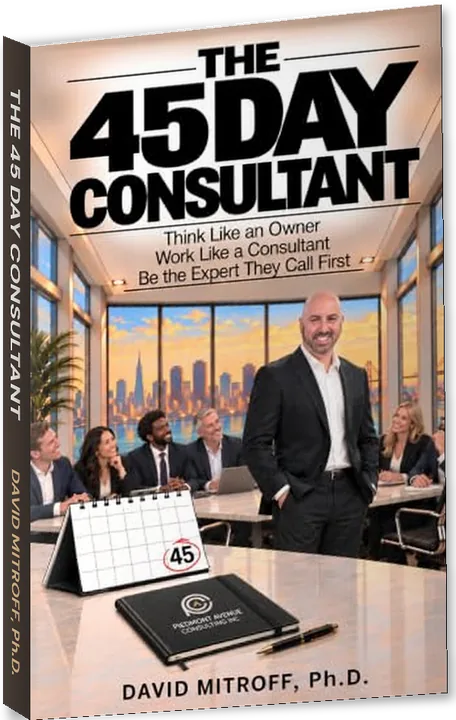
The 45 Day Consultant
This is also in David’s book, The 45 Day Consultant, in the chapter “Social Media Marketing”.
Read the topic guideAll topics from the bookGet the book on Amazon
Take action
Your next three steps
- Update your headline so a stranger knows in one line who you serve and what you do.
- Pick one industry or city and connect with ten people in it, with no pitch attached.
- Connect with everyone you met at your last event and send one of them a note suggesting coffee.
In their own words
What clients say about working with us
“McDowall Cotter started working with David Mitroff and right away things started to happen. We have managed to fill up our seminar rooms again, he has found us great new staff to run our marketing department, and business is booming. More than a marketing consultant, he is also a business confidant, helping us keep course on our goal to growth.”
 David RosenbaumPartner, McDowall Cotter, APC

“I have known and worked with David for over 15 years, across numerous companies and ventures. He helped us build and promote Clark Meyers. He is my go-to marketing guru and has introduced me to the resources I need to grow.”
 Conor MeyersCo-Founder, Clark Meyers PC

Read more client stories or see our case studies.
Frequently asked questions
Frequently asked questions
Is LinkedIn useful for small business owners?
Yes. LinkedIn is a searchable list of professionals by location, title, industry and mutual connections, so small business owners can use the platform to find partners, invite people to events, stay visible and follow up after meeting someone.
Do I include a message with a LinkedIn connection request?
A bare connection request with no pitch is usually the better choice, because a request costs the other person nothing and most people accept, while a sales pitch attached to a request tends to get ignored.
Do I need LinkedIn Premium for my business?
No. The value of LinkedIn comes from building relationships, sharing insights and staying visible to your network, and a basic account with a complete profile is enough to start.
How often does a business owner need to post on LinkedIn?
A business owner gets the most from LinkedIn by posting consistently, such as one useful idea a week, because each post can bring a reply right away and be found again months later.
What goes in a LinkedIn headline for a business owner?
A business owner’s LinkedIn headline names who the owner serves and what the business does in one line, such as the kind of clients, the service and the area served, instead of a job title alone.
How do I follow up on LinkedIn after an event?
After an event, connect on LinkedIn with the people you met the same day, then send one of them a short note suggesting coffee, and invite your new connections to your next event.
Does Piedmont Avenue Consulting, Inc. work with owners on LinkedIn and networking?
Yes. Piedmont Avenue Consulting, Inc. plans LinkedIn, networking and relationship marketing with owners in the San Francisco Bay Area, Los Angeles, Orange County and New York. Schedule a call with David to talk about your business.
Let’s grow together.
Schedule a call with David. Bring your LinkedIn profile, and we will look at who to connect with first.
Or call David at 510-761-5895, 8 AM to 8 PM, seven days a week.
About the author
David Mitroff, Ph.D. wrote this article. He is the founder of Piedmont Avenue Consulting, Inc., a business and marketing consulting firm serving the San Francisco Bay Area, Los Angeles, Orange County and New York. Meet David or read more articles by David.
- Founder and Business Growth Strategist at Piedmont Avenue Consulting, Inc.
- Doctorate in clinical psychology, with additional coursework in business administration, law and culinary arts; bachelor’s and master’s degrees.
- Taught marketing and entrepreneurship at the University of California, Berkeley for more than seven years.
- Author of several books, including The 45 Day Consultant, The 45 Day Consultant Field Guide, Online Business Growth Strategies, The Event Effect: Invite, Don’t Sell, and Law Firm Business Growth Strategies (Second Edition).
- Started seven companies; previously owned and ran a recruiting and staffing company.
David works with a small team of consultants and specialists on every engagement. Meet our team or read about Piedmont Avenue Consulting, Inc.