



A call with David Mitroff, Ph.D.
Talk through your business with David
Quick answer
David connected with people in the yacht world on LinkedIn, wrote useful articles about yachts and kept showing up. Then the owner of the largest yacht brokerage in Northern California called and hired him. Owners can do the same in any industry: connect with the people in it, publish something worth reading, go where they gather and host useful rooms for them, for long enough that people recognize you. Piedmont Avenue Consulting, Inc. works with owners entering new industries and markets across the San Francisco Bay Area, Los Angeles, Orange County and New York.
Key takeaways
- A cold pitch asks a stranger for something, while a useful article gives the reader something first and keeps working after you post it.
- David connected with yacht brokers on LinkedIn, wrote useful yacht articles, and the owner of the largest yacht brokerage in Northern California hired him.
- David describes luck as three things: visibility, trust and timing, and steady showing up puts you in place when timing is right.
- Getting known in an industry rarely happens in a month, as the booth example shows recognition building over three years.
Most owners who want to get known in a new industry start with a sales pitch, and most of those pitches go nowhere. At Piedmont Avenue Consulting, Inc., we are a business and marketing consulting firm that works with owners in the San Francisco Bay Area, Los Angeles, Orange County and New York to start, grow and scale their businesses. David Mitroff, Ph.D., tells a different kind of story in The Event Effect, about how a few blog articles put him on private yachts and brought in a client.
How David ended up on private yachts
A while back, David wanted to get to know people in the yacht world.
Instead, he connected with yacht brokers, yacht dealers and other people in the industry on LinkedIn. Then he wrote blog articles about yachts and posted them on his website, on LinkedIn and anywhere else people in that world might see them.
Then the phone rang. The owner of the largest yacht brokerage in Northern California called and hired him as a consultant. For the next two to three years, David worked with the company to sell more yachts and grow the business, and he went out on the water about twenty-five times a year, on powerboats, sailboats and everything in between.
“From the outside, it looked lucky. It was not. I put myself where the right people could see me, I gave them something worth reading, and the invitation came back.”
David Mitroff, Ph.D., in The Event Effect, Chapter 3: How Leaders Create Luck
The same pattern with hotels
The yacht story was not a one-time accident. When David wanted to work with hotels, he did the same thing in person. He did not send cold pitches. He looked up hotel associations, started showing up and told people he was interested in the hotel industry. Before long, he met an owner of several hotels, who hired him.
“Brand building is mostly a matter of putting yourself where you want to be known, and then being useful once you’re there.”
David Mitroff, Ph.D., in The Event Effect, Chapter 15: Events That Build a Brand
And again with law firms
The pattern repeated a third time, with an industry David is not part of. He is not an attorney. He taught continuing education workshops at law firms on topics like social media policies, legal research and reputation management, and attorneys who had seen him teach called when they needed to grow their firms.
“Those workshops did something no ad could. They made me a familiar face inside law firms.”
David Mitroff, Ph.D., in The Event Effect, Chapter 15: Events That Build a Brand
Yachts through articles, hotels through associations, law firms through teaching. Three different doors, one approach: be visible, be useful and keep coming back. Our plain definition of what a continuing education workshop is explains the teaching door for owners whose buyers are licensed professionals.
Choosing the industry to enter
Before you connect with anyone, decide where you are going. An owner who tries to break into five industries at once ends up known in none of them.
A few questions sort the options:
- Where do your skills solve a problem people already pay to fix?
- Which industries do your best current clients come from? The next client often looks like the last good one.
- Where do you have a personal interest? You will keep showing up longer for an industry you enjoy.
- Is the industry gathered somewhere you can reach? Associations, trade groups, conferences and online groups make the work easier.
- Can you name ten people in it you would like to meet? If not, start by finding those ten.
Write the answer down in one sentence, such as “I want to work with independent hotels in Northern California.” Our guide on what a target market is covers how to narrow it further.
Why the pitch loses and the article wins
A cold pitch asks a stranger for something. An article gives the reader something first. It tells the right people who you are, what you know and what you care about, and it keeps working after you post it. A reader who finds it useful remembers your name, and a reader who needs a consultant knows where to find you.
“Good work only creates opportunity when the right people can see it.”
David Mitroff, Ph.D., in The Event Effect, Chapter 3: How Leaders Create Luck
David describes luck as three things: visibility, trust and timing. The articles made him visible to the yacht world. The useful content built trust. And because he kept showing up, he was the person the owner remembered when the timing was right. Our article on how leaders create luck goes deeper on all three.
Step one in detail: connect
LinkedIn is the easiest place to start, because the people in almost every industry list their title and company there. The goal is not a thousand connections. It is the right few hundred, added steadily.
- Start with the people closest to the buyer: owners, general managers, partners and department heads.
- Add the people who serve the industry: brokers, suppliers, attorneys, accountants and the staff of its associations.
- Send a short, personal note with each request. “I’m learning more about the yacht world and enjoyed your post on the boat show” works better than a pitch.
- Add a handful each week, so the network grows without becoming a chore.
- Comment on their posts with something thoughtful before you ask anyone for anything.
Our list of LinkedIn myths for business owners covers the beliefs that keep owners from using it well.
Step two in detail: publish
The articles are what turned connections into a phone call. You do not need to be a great writer. You need to answer the questions people in that industry actually have.
Where to find the questions
- Listen at association meetings and note what people complain about.
- Read the questions people post in industry groups.
- Ask your first few contacts what they wish someone would explain.
- Look at what the industry’s own trade publications cover, then find the gap.
What to write first
- A plain guide to one problem the industry faces, with steps they can use.
- A short list of mistakes you see owners in that field make.
- A question-and-answer piece built from real questions you heard.
- A short video walking through one idea from your article.
Post each piece on your website, share it on LinkedIn and send it to the people you have met. Being one of the few voices on a topic counts for a lot.
“If you’re one of the few talking about a new concept (consistently, publicly) you’ll quickly be seen as an expert.”
David Mitroff, Ph.D., in The 45 Day Consultant, Chapter 29: Future Trends in Consulting
Put the topics on a calendar, so one article a month goes out whether or not the week was quiet. Our guide on how to build a twelve-month marketing calendar shows how.
Step three in detail: show up
Articles reach people on their own schedule. Showing up puts a face to the name. David’s hotel story turned on one plain sentence repeated at association events: he was interested in the hotel industry.
- Join or attend the main association for the industry and go to the same meetings for a year.
- Volunteer for a committee or an event, which gives you a reason to talk with the organizers.
- Introduce yourself the same way each time, so people start to repeat it for you.
- Follow up after each meeting with one useful thing: an article, an introduction or an answer to a question they asked.
Trying to break into a new industry?
Schedule a call with David Mitroff, Ph.D. We look at the industry you want and the first rooms to walk into.
Or call David at 510-761-5895, 8 AM to 8 PM, seven days a week.
Give it time
Getting known in an industry rarely happens in a month. David uses the picture of a new business with a booth at a big community event. The first year, the team spends the day explaining who they are. The second year, people walk by and say they have seen them before. The third year, people say they have been to the restaurant, or that the business is their dentist.
“Nothing changed about the booth. What changed was three years of showing up.”
David Mitroff, Ph.D., in The Event Effect, Chapter 3: How Leaders Create Luck
How to get known in a new industry
- Pick one industry where you want to work, and write down why your skills fit it.
- Connect with the people in it on LinkedIn: owners, managers, brokers, suppliers and the associations that serve them.
- Publish something useful for that industry: an article, a short guide or a video that answers a real question people in it have.
- Find where the industry gathers, such as associations, trade groups and conferences, and start showing up.
- Tell people what you are interested in. A plain “I’m interested in the hotel industry” opens more doors than a pitch.
- Host a useful event for the industry once you know a few people: a panel, a workshop or a small dinner. Our guide on how to host a panel discussion covers the easiest format.
- Keep going for a year or more before you judge the results.
Host a useful event
Once you know a few people, hosting moves you from guest to host, and people follow up with the host. David did this early on with small industry gatherings.
“I also started hosting niche events: brunches for people in hospitality, real estate, law, construction, etc. Those gatherings gave me deeper industry insights, and I eventually started working with those types of clients.”
David Mitroff, Ph.D., in The 45 Day Consultant, Chapter 18: Putting Your Ideas into Action
The room can be small. Six people from one industry around a brunch table, a panel of three experts at an association meeting or a workshop on one problem all work. Our comparison of the types of business events covers which format fits which goal.
“Want to be known in an industry? Host useful rooms for that industry.”
David Mitroff, Ph.D., in The Event Effect, Chapter 15: Events That Build a Brand
Our guides on how to become the expert people call in your industry and how to enter a new market cover the longer road, and our article on law firm marketing workshops shows how the same approach made law firms some of David’s best clients.
Three owners, three industries
Here is how the same steps look for different kinds of businesses.
A bookkeeper who wants restaurant clients. The bookkeeper connects with restaurant owners and general managers on LinkedIn, writes a short guide to the numbers a restaurant owner reviews each week and attends the local restaurant association. After a few months, a small breakfast for owners on one topic, such as food costs, puts the bookkeeper at the head of the table.
A marketing firm that wants dental practices. The firm publishes a list of common mistakes on dental websites, comments on posts from practice owners and teaches a short session for a dental study group. The teaching does what the ads did not: it makes the firm a familiar face.
A contractor who wants medical office work. The contractor connects with property managers and practice administrators, writes about what makes a medical office build different from an ordinary office, and hosts a walk-through of a finished clinic for a small group of administrators.
If you feel like an outsider
Almost everyone entering a new industry worries that people will see them as a stranger who does not belong. That feeling fades with each conversation and each article.
“The truth is, you just have to start. You become an expert by doing.”
David Mitroff, Ph.D., in The 45 Day Consultant, Chapter 18: Putting Your Ideas into Action
David’s story of forty-five days as a stand-up comic shows how quickly a beginner can become the person others ask. Being new also has an advantage: you ask questions insiders stopped asking, and those questions make good articles.
How to tell whether it is working
Results in a new industry take time, so track the early signs that come before the first client:
- Connections accepted and replies to your notes.
- Comments and shares on your articles from people in the industry.
- Faces that recognize you at the second and third association meeting.
- Invitations to speak, write or join a committee.
- Introductions offered by people in the industry.
- First conversations about paid work.
If the early signs are growing after six months, keep going. If nothing is moving, look at whether you picked the right gatherings and whether your articles answer questions people actually have.
Common mistakes when entering a new industry
- Leading with a pitch. Strangers ignore a sales message and remember a useful article.
- Spreading across several industries. Pick one and stay with it long enough to be recognized.
- Writing for yourself. Write about the industry’s problems, not your services.
- Going to one meeting and stopping. Recognition comes from the second, third and tenth visit.
- Waiting until you feel like an expert. You become one by doing the work in public.
- Forgetting to follow up. Each new contact needs a next step, or the meeting fades.
What to do this week
- Write one sentence naming the industry you want to be known in and why.
- Connect with ten people in that industry on LinkedIn, each with a short personal note.
- List five questions people in the industry ask, and pick one for your first article.
- Find the main association or trade group and put its next meeting on your calendar.
- Tell three people you already know that you are interested in that industry.

How we work with owners entering a new industry
We choose the industry with the owner, build the list of people and associations to connect with, plan the articles and the first events, and set up the follow-up so each new contact turns into a relationship. In the first ninety days of working together, our job is to find our fee, which means making or saving you more than you pay us. We start with an initial consultation and a paid assessment, then build a ninety-day plan and a twelve-month marketing calendar. Learn more about our business consulting services.
From David’s books

The 45 Day Consultant Field Guide
This is also in David’s book, in Chapter 12, “When Are You Good Enough to Become an Industry Expert?” and Chapter 14, “How Leaders Create Luck”. Each chapter page sums up the idea, the story behind it and what to do next.
Read Chapter 12Read Chapter 14See all 22 chaptersGet the book on Amazon
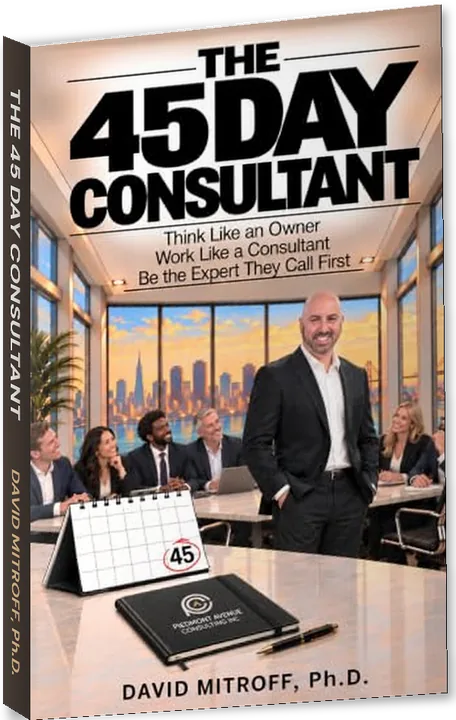
The 45 Day Consultant
This is also in David’s book, The 45 Day Consultant, in the chapter “Social Media Marketing”.
Read the topic guideAll topics from the bookGet the book on Amazon

Run a law firm?
David Mitroff, Ph.D. covers this for attorneys in Law Firm Business Growth Strategies, Second Edition, in the chapter “Becoming Known”.
Read the chapter guideLaw Firm Growth GuideLaw firm consultingGet the book on Amazon
Quick self-assessment
Score your law firm
Answer nine questions and get an initial score out of 100 for how easy your firm is to find and choose online. It is written for law firms, and built on the nine keys from David Mitroff, Ph.D.’s book Online Business Growth Strategies.
Score your law firmQuick self-assessment
Score your restaurant
Answer nine questions and get an initial score out of 100 for how easy your restaurant is to find and choose online. It is written for restaurants, and built on the nine keys from David Mitroff, Ph.D.’s book Online Business Growth Strategies.
Score your restaurantTake action
Your next three steps
- Connect on LinkedIn with owners, managers, brokers, suppliers and associations in your chosen industry.
- Publish an article, short guide or video that answers a real question people in the industry have.
- Host a useful panel, workshop or small dinner for the industry once you know a few people.
In their own words
What clients say about working with us
“McDowall Cotter started working with David Mitroff and right away things started to happen. We have managed to fill up our seminar rooms again, he has found us great new staff to run our marketing department, and business is booming. More than a marketing consultant, he is also a business confidant, helping us keep course on our goal to growth.”
 David RosenbaumPartner, McDowall Cotter, APC

“I have known and worked with David for over 15 years, across numerous companies and ventures. He helped us build and promote Clark Meyers. He is my go-to marketing guru and has introduced me to the resources I need to grow.”
 Conor MeyersCo-Founder, Clark Meyers PC

Read more client stories or see our case studies.
Frequently asked questions
Frequently asked questions
How do I get known in a new industry?
Getting known in a new industry starts with connecting with the people in that industry on LinkedIn, publishing useful articles for them, showing up at their associations and events, and hosting a useful room for the industry once you know a few people.
Does writing articles bring in clients?
Writing useful articles brings in clients when the right people can see the articles. David Mitroff, Ph.D., wrote blog articles about yachts, and the owner of the largest yacht brokerage in Northern California called and hired him as a consultant.
How long does getting known in an industry take?
Getting known in an industry often takes a year or more of steady effort. David Mitroff, Ph.D., describes a booth at a community event that people recognize in the second year and treat as familiar by the third.
Is a cold pitch a good way to break into an industry?
A cold pitch asks a stranger for something, while a useful article, a question at an association meeting or an invitation to a panel gives first, which tends to build more trust in a new industry.
What do I write about to get known in a new industry?
Write about the questions people in that industry already ask: a plain guide to one problem they face, a list of common mistakes or a question-and-answer piece built from what you hear at their meetings.
How do I choose which industry to enter?
Choose an industry where your skills solve a problem people already pay to fix, where your best current clients come from, where you have a real interest and where people gather in associations or events you can reach.
Does Piedmont Avenue Consulting, Inc. work with owners entering new industries?
Yes. Piedmont Avenue Consulting, Inc. works with owners entering new industries and markets in the San Francisco Bay Area, Los Angeles, Orange County and New York. Schedule a call with David to talk about your business.
Let’s grow together.
Schedule a call with David. Tell us which industry you want to be known in, and we will look at the first steps together.
Or call David at 510-761-5895, 8 AM to 8 PM, seven days a week.
About the author
David Mitroff, Ph.D. wrote this article. He is the founder of Piedmont Avenue Consulting, Inc., a business and marketing consulting firm serving the San Francisco Bay Area, Los Angeles, Orange County and New York. Meet David or read more articles by David.
- Founder and Business Growth Strategist at Piedmont Avenue Consulting, Inc.
- Doctorate in clinical psychology, with additional coursework in business administration, law and culinary arts; bachelor’s and master’s degrees.
- Taught marketing and entrepreneurship at the University of California, Berkeley for more than seven years.
- Author of several books, including The 45 Day Consultant, The 45 Day Consultant Field Guide, Online Business Growth Strategies, The Event Effect: Invite, Don’t Sell, and Law Firm Business Growth Strategies (Second Edition).
- Started seven companies; previously owned and ran a recruiting and staffing company.
David works with a small team of consultants and specialists on every engagement. Meet our team or read about Piedmont Avenue Consulting, Inc.