



A call with David Mitroff, Ph.D.
Talk through your business with David
Quick answer
Many professionals are required to keep learning, and they look for good courses all the time. When you get approved to teach, your workshop gives them a reason to show up that has nothing to do with being sold to. Teach about the practice, give the room something to keep and follow up afterward. Piedmont Avenue Consulting, Inc. works with owners and experts across the San Francisco Bay Area, Los Angeles, Orange County and New York on exactly that plan.
Key takeaways
- A continuing education workshop is a class or webinar that licensed professionals attend to earn the credits their license requires.
- The audience already has a reason to come, so the invitation offers something professionals already have to find.
- For lawyers, topics have to be about the practice and the business of law, since the credit depends on teaching.
- David has delivered more than three hundred workshops, webinars and presentations for lawyers, and many host firms became consulting clients.
What is a continuing education workshop? It is a class, a webinar or a presentation that licensed professionals attend to earn the education credits their license requires, taught by an expert who has been approved to offer that credit. At Piedmont Avenue Consulting, Inc., we are a business and marketing consulting firm that works with owners in the San Francisco Bay Area, Los Angeles, Orange County and New York to start, grow and scale their businesses. For an owner or an expert who serves professionals, a continuing education workshop is one of the most useful events there is, because the audience already has a reason to come.
The plain definition
A continuing education workshop is an event built around a requirement. Lawyers, accountants, nurses, real estate agents and many other professionals have to complete a set amount of approved education to keep their licenses. In The Event Effect, David Mitroff, Ph.D., gives an example from California, where attorneys need twenty-five hours of approved continuing legal education every three years.
The workshop itself can be a class in a conference room, a session at a bar association or a webinar. What makes it continuing education is the approval: the course and the provider meet the rules of the body that grants the credit, and attendees earn credit for the time they spend.
The parts of a continuing education workshop
Every continuing education workshop has the same few pieces, whatever the profession:
- An audience with a requirement. Professionals who need a set number of approved hours to keep a license.
- An approved course. A topic and an outline that meet the rules of the body that grants the credit.
- A qualified presenter. Someone with real knowledge of the subject, approved to teach it or teaching through a provider that is.
- A host. A firm, an association or a program that brings the room together, in person or online.
- Something to keep. Slides, a checklist, a guide or a book that attendees take back to the office.
- A record. Attendance and credit tracking, so each professional can report the hours.
- A follow-up. A note afterward with the materials and an invitation to the next session.
The first six pieces earn the credit. The seventh is where an expert’s relationships grow.
“They’re looking for good courses all the time.”
David Mitroff, Ph.D., in The Event Effect, Chapter 15: Events That Build a Brand
Why a continuing education workshop fills up
Most events have to give people a reason to come. A continuing education workshop starts with one. The professionals in the room need the credit, and a useful course is one they are glad to find. That changes the invitation. You are not asking people with full schedules to give up an evening for a pitch. You are offering them something they already have to find.
Think about the difference from the guest’s side. A marketing mixer asks an attorney to leave the office early, find parking and hope the room is worth it. A continuing education workshop on a topic they care about lets the same attorney learn something useful and earn hours they would otherwise have to find on a weekend. The second invitation is easier to say yes to, and easier to pass along to a colleague.
“Find out what education your audience needs, and become the person who provides it.”
David Mitroff, Ph.D., in The Event Effect, Chapter 15: Events That Build a Brand
What a continuing education workshop is not
- A sales presentation. For lawyers, David writes, the topics have to be about the practice and the business of law, not marketing. The credit depends on teaching.
- A one-time event. The value comes from teaching again and again, so the same professionals see you as the person who teaches their field.
Want to teach the professionals you serve?
Schedule a call with David Mitroff, Ph.D. We look at your audience, your topics and the rooms worth teaching in.
Or call David at 510-761-5895, 8 AM to 8 PM, seven days a week.
Who teaches continuing education
You do not have to be a member of a profession to teach it something useful. David is not an attorney, and law firms became some of his best clients through the workshops he taught them. The best presenters are experts who see a profession from a useful angle, often from the outside.
Here is how that can look for a few kinds of experts, wherever the rules of the profession allow it:
- A consultant who works with professional firms teaches the business side of the practice: client intake, hiring, how a firm keeps clients for years.
- A technology or records specialist teaches how a firm handles research, documents or the tools it already pays for.
- An insurance or risk professional teaches the risks a profession faces and the habits that reduce them.
- An experienced practitioner teaches newer members of the same field what the first years of practice are really like.
In each case the topic serves the professional’s work. The presenter’s own business benefits as a side effect, because the room now knows who to call. Our page on law firm marketing and consulting shows how that teaching connects to the rest of our work with firms.
Choose a topic that teaches
The topic decides whether the course can earn credit and whether anyone wants to attend. Test each idea against a few questions before you build it.
Is it about the practice?
For lawyers, the topics have to be about the practice and the business of law. Other professions have their own lines. If a topic only makes sense as a reason to hire you, it is a sales talk and will not earn credit.
Is it a problem they face this year?
The strongest topics answer a question professionals are already asking each other: a new tool, a new risk, a change in how clients behave. David’s social media policy course works because firms and their clients are on social media every day, and the risks are real.
Can they use it on Monday?
Give the room something to apply right away: a checklist, a template, a short policy outline or a set of questions to ask their own team. Attendees remember the presenter whose material they used the following week.
Can you teach it more than once?
Pick a topic you can deliver many times, in many rooms, and refresh each year. One strong course taught again and again builds more recognition than a new topic every time. Our page on legal education programs shows the kinds of topics that work for law firms.
What it looks like in practice
David got approved to teach lawyers. He has delivered more than 300 MCLE workshops, webinars and presentations for lawyers and law firms, across Piedmont Avenue Consulting, Inc., LexisNexis, CEB and the San Francisco Bar Association. One of his most requested topics is social media policies: what a firm’s policy says, what the firm tells its clients and real cases where social media got people in trouble. Every attendee gets a copy of his law firm book.
He has also given business-of-law webinars for CEB, the continuing education program for California lawyers, with hundreds of attorneys in each one. His titles included “Turn Your Network into Revenue” and “How to Use LinkedIn to Grow Your Firm.”
The rooms kept leading to more rooms. David writes that firms that had hosted one workshop asked for another, and many of them became consulting clients. Our guide to law firm marketing that works tells more of that story.
David describes what those rooms did for the practice in two short lines.
“Those workshops did something no ad could. They made me a familiar face inside law firms.”
David Mitroff, Ph.D., in The Event Effect, Chapter 15: Events That Build a Brand
Plan the workshop backward from the follow-up
Most of the work happens before anyone walks in. Plan from the follow-up you want to send, then work back to the date.
Two to three months out
- Confirm the rules for the profession, including how a course gets approved and what records attendees need.
- Pick the topic, write a short outline and choose what attendees will take home.
- Agree on a host and a format: a session at a firm, a program with an association or a webinar.
One month out
- Finish the slides and the take-home material, with real examples and no sales pitch.
- Send the invitation through the host, and ask the host to name it as an education session with credit.
- Write the follow-up email now, so it is ready the morning after.
The week of the workshop
- Send a reminder with the time, the place or the link, and how credit will be recorded.
- Prepare a sign-in sheet or registration list for the attendance record.
- Bring copies of the take-home material, or have the file ready to send.
The day after
- Send the slides and materials to every person who registered, including those who did not attend.
- Thank the host, and ask what topic their members want next.
- Note every attendee who asked a question or stayed to talk, and follow up with each one personally.
At the workshop: teach the whole time
A continuing education session asks for something many experts find hard: no pitch at all. The room came to learn, and the rules expect teaching. That restraint is exactly what builds trust. When attendees leave having learned something real, the expert becomes someone they want to hear from again.
A few habits keep the session useful:
- Open with a question the room cares about, and come back to it at the end.
- Use real cases, told with details changed, so the lesson sticks.
- Leave time for questions. The questions tell you what to teach next time.
- Stay afterward. The conversations by the door are often the most valuable part of the day.
The same habits carry over to keynotes and panels. Our speaking page describes the talks David gives for associations and conferences.
After the workshop: follow-up is where the value grows
The materials you send afterward keep teaching long after the session ends. Some people will read them without ever having been in the room. David has seen how far that can carry.
“I’ve had people read one of my presentations, hire me without ever seeing me speak, and then work with me every month for years.”
David Mitroff, Ph.D., in The Event Effect, Chapter 14: Follow-Up Is Where the Value Is
Send the slides to everyone who registered. Invite them to the next session. Ask the host what their members want next. Our guide on how to turn relationships into revenue covers how to keep those conversations going without turning them into a pitch.
How to start
- Learn what your audience needs. Find out which credits your clients need and which topics they struggle to find.
- Check the rules. Each profession sets its own rules for what counts, who can teach and how a course gets approved. Read them before you plan the first workshop.
- Build a course that teaches. Pick a topic about the practice, with real examples and something to keep, such as a book, a checklist or a guide.
- Partner with a host. A bar association, a professional association or a firm can bring the room. Our definition of a strategic partner covers how to find one.
- Teach it again. Offer the same course in more rooms, then add a second topic.
- Follow up with everyone. Send the slides to every person who registered, and invite them to the next one. Our follow-up system shows how.
Why it builds a brand
David writes that the same pattern has worked for him in hospitality, construction and real estate: host useful rooms for an industry, and do it again. A continuing education workshop is the clearest version of that pattern. The professionals in the room learn something they need, from you, in a setting where nobody is selling. Over time, you become the person their field turns to. Our guide on how to become the expert people call in your industry covers the rest of the path.
David sums up the pattern in a few words.
“Want to be known in an industry? Host useful rooms for that industry. Do it again. And again.”
David Mitroff, Ph.D., in The Event Effect, Chapter 15: Events That Build a Brand
Three experts, three continuing education programs
- An expert who serves law firms starts with one course on the business of running a small firm, taught at a local bar association. After the first session, two firms ask for an in-house version. A year later, the expert teaches the course a few times each season and has a second topic ready. The workshops and events section of our law firm growth guide covers that rhythm.
- An expert who serves accountants learns that the slow season for accountants is the best time to teach them. The expert offers a short webinar series in those months, with a checklist attendees can use with their own clients.
- An expert who serves real estate agents partners with a brokerage that already runs training for its agents. The brokerage brings the room, the expert brings a course on a problem agents face every week, and both send the follow-up together.
Common mistakes with continuing education workshops
- Slipping in a pitch. It breaks the trust of the room and can put the credit at risk.
- Skipping the rules. Each profession sets its own requirements. Read them before you plan.
- Teaching once and stopping. Recognition comes from repetition, in more rooms, over years.
- Sending nothing afterward. Without the follow-up, the session ends at the door.
- Choosing a topic only you find interesting. Ask the host and past attendees what they want to learn.
- Planning without a host. A respected partner brings the room and lends credibility you cannot buy.
How to measure a continuing education program
Track a few numbers for every session and look at the trend over a year.
- Registrations and attendance, and how many came back for a second session.
- Requests from hosts for another session or an in-house version.
- Follow-up conversations booked in the weeks after each workshop.
- Introductions from attendees to colleagues or other firms.
- New clients who first met you in a workshop, tracked by asking every new client how they found you.
What to do this week
- Ask three clients which continuing education topics they struggle to find.
- Look up the rules of the profession you want to teach, including how a course gets approved.
- Draft a one-page outline for one course that teaches, with something attendees can keep.
- Make a list of the associations, programs and firms that could host it.
- Write the follow-up email you would send the morning after the first session.

How we work with owners and experts
We look at who your clients are, find the education they need, choose the topics and the partners and build the invitations and follow-up that turn each workshop into relationships. In the first ninety days of working together, our job is to find our fee, which means making or saving you more than you pay us. We start with an initial consultation and a paid assessment, then build a ninety-day plan and a twelve-month marketing calendar. Learn more about our business consulting services.
From David’s books

Run a law firm?
David Mitroff, Ph.D. covers this for attorneys in Law Firm Business Growth Strategies, Second Edition, in the chapter “Workshops and Events”.
Read the chapter guideLaw Firm Growth GuideLaw firm consultingGet the book on Amazon
The Event Effect
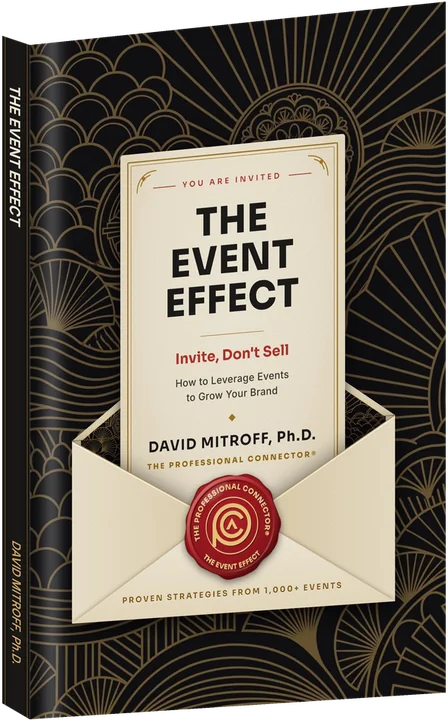
David wrote the book on events that grow a business. The Event Effect, now in its second edition, covers how to plan, fill, host and follow up on them.
Quick self-assessment
Score your law firm
Answer nine questions and get an initial score out of 100 for how easy your firm is to find and choose online. It is written for law firms, and built on the nine keys from David Mitroff, Ph.D.’s book Online Business Growth Strategies.
Score your law firmTake action
Your next three steps
- Find out which credits your clients need and which topics they struggle to find.
- Read your profession’s rules on what counts, who can teach and how a course gets approved.
- Partner with a bar association, professional association or firm that can bring the room.
In their own words
What clients say about working with us
“David was extremely helpful, and the most responsive consultant I’ve ever worked with. If he didn’t know something, he had no problem acknowledging that, and calling in an expert. His follow-up was absolutely impeccable.”
 Judith Szepesi, J.D.Partner, Blakely Sokoloff Taylor & Zafman

Read more client stories or see our case studies.
Frequently asked questions
Frequently asked questions
What is a continuing education workshop?
A continuing education workshop is a class, webinar or presentation that licensed professionals attend to earn the education credits their license requires, taught by an approved provider.
Who needs continuing education?
Lawyers, accountants, nurses, real estate agents and many other licensed professionals are required to complete approved continuing education to keep their licenses.
Why do continuing education workshops attract professionals?
Professionals with full schedules need the credit, so a useful course gives them a reason to attend that has nothing to do with being sold to.
Can a continuing education workshop be about marketing?
For lawyers, the topics have to be about the practice and the business of law, not marketing. Each profession sets its own rules for what counts.
Who can teach a continuing education workshop?
An expert with real knowledge of a subject can teach a continuing education workshop when the course and the provider meet the rules of the body that grants the credit. Each profession sets its own requirements for who can teach.
How does a continuing education workshop lead to new clients?
A continuing education workshop makes the presenter a familiar face to the professionals in the room. When the teaching is useful and the follow-up is consistent, attendees call when they need support, and hosts ask for more sessions.
Does Piedmont Avenue Consulting, Inc. work with experts who teach professionals?
Yes. Piedmont Avenue Consulting, Inc. works with owners and experts in the San Francisco Bay Area, Los Angeles, Orange County and New York on workshops, partnerships and follow-up. Schedule a call with David to talk about your audience.
Let’s grow together.
Schedule a call with David. Tell us who your clients are, and we will look at what you could teach them.
Or call David at 510-761-5895, 8 AM to 8 PM, seven days a week.
About the author
David Mitroff, Ph.D. wrote this article. He is the founder of Piedmont Avenue Consulting, Inc., a business and marketing consulting firm serving the San Francisco Bay Area, Los Angeles, Orange County and New York. Meet David or read more articles by David.
- Founder and Business Growth Strategist at Piedmont Avenue Consulting, Inc.
- Doctorate in clinical psychology, with additional coursework in business administration, law and culinary arts; bachelor’s and master’s degrees.
- Taught marketing and entrepreneurship at the University of California, Berkeley for more than seven years.
- Author of several books, including The 45 Day Consultant, The 45 Day Consultant Field Guide, Online Business Growth Strategies, The Event Effect: Invite, Don’t Sell, and Law Firm Business Growth Strategies (Second Edition).
- Started seven companies; previously owned and ran a recruiting and staffing company.
David works with a small team of consultants and specialists on every engagement. Meet our team or read about Piedmont Avenue Consulting, Inc.