


A call with David Mitroff, Ph.D.
Talk through your business with David
Quick answer
Our view, in short: decide before you plan what success looks like the morning after, write it in one sentence, and count the meetings, partnerships and opportunities the event creates. A small room of the right people beats a big room of the wrong ones. And sometimes the honest answer is that an event is not the right tool yet. Piedmont Avenue Consulting, Inc. plans and measures events with owners across the San Francisco Bay Area, Los Angeles, Orange County and New York.
Key takeaways
- Head count measures attendance and says nothing about whether the right people came or whether anything happens next.
- Judge every event by the qualified meetings, partnerships and opportunities it creates, not by how many people walked through the door.
- If you cannot say what success looks like the morning after in one sentence, you are not ready to send invitations.
- A room built for one kind of guest is easier to measure, since you can see whether those guests came and booked.
Knowing how to measure event success starts with dropping the one number most owners use, the head count. At Piedmont Avenue Consulting, Inc., we are a business and marketing consulting firm that works with owners in the San Francisco Bay Area, Los Angeles, Orange County and New York to start, grow and scale their businesses. David Mitroff, Ph.D., hosts networking mixers and executive dinners through The Professional Connector®, and in The Event Effect he makes a simple case: judge an event by what happens after it, not by how full the room looked.
Why head count misleads
A full room feels like a win. The photos look good, the team is tired in a satisfying way and everyone says it was a great night. Then a month goes by and nothing comes of it.
“Eighty people who drank your wine and left are not a success. Twelve people, three of whom book a follow-up call, are.”
David Mitroff, Ph.D., in The Event Effect, Chapter 4: Start With Why
Head count measures attendance. It says nothing about whether the right people came, whether they talked to you or whether anything happens next.
Count meetings, not heads
“I judge every event by the qualified meetings, partnerships and opportunities it creates, not by how many people walked through the door.”
David Mitroff, Ph.D., in The Event Effect, Chapter 4: Start With Why
Here is what we count after an event:
- Follow-up meetings booked with people who fit the room you planned for
- Partnerships started, such as a co-hosted event or a referral arrangement
- Opportunities created, such as a proposal requested, a private event booked or a speaking invitation
- New names on the list of the people you most want to know
- Replies to the invitation, including the “can’t make it, keep me posted” replies
The last one surprises owners. An invitation reaches far more people than the room holds, and every one of them learns who you are and what you care about.
“About eighty percent of why you do an event is everything before and after it. The event itself is the other twenty percent.”
David Mitroff, Ph.D., in The Event Effect, Chapter 4: Start With Why
Our story about the January party behind The Event Effect shows how an event can pay off even when few people come.
Work out the cost per meeting
Cost per guest is the number most owners reach for first. It is easy to figure, and it feels responsible. The number that tells you more sits one step further down the page.
“After the event, divide what you spent by the number of people who came. Then divide it by the number of meetings you booked. That second number is the one that matters.”
David Mitroff, Ph.D., in The Event Effect, Chapter 18: What Events Cost
Here is how to run it:
- Add up the full cost. Include the venue, food and drink, printing, any gifts at the seats and the hours your team spent on invitations and follow-up.
- Count the meetings that came from the room. Only count meetings with people who fit the guest you planned for.
- Divide the cost by the meetings. That figure is your cost per meeting.
- Compare it with what one good client is worth. If one new client relationship is worth far more than the cost per meeting, the event earned its place.
A small dinner with a handful of the right guests often wins this math over a large mixer. The large room costs more and spreads your attention thin. The small room gives you a real conversation with every person in it. Our guide on how to budget for a business event walks through each cost line.
Decide what success looks like before you book the venue
The time to choose your measure is before the first invitation, not after the last guest leaves.
“Before you book a room, order food or design a single invitation, answer one question: what does success look like the morning after?”
David Mitroff, Ph.D., in The Event Effect, Chapter 4: Start With Why
David walks owners through four questions:
- Who is this room for? Name the people, not “everyone.”
- What do they get out of it? Something to taste, learn, see or meet that they cannot get anywhere else.
- What do you want to happen afterward? Pick one or two outcomes: a meeting, a partnership, a sponsor, a booked private event or a client conversation.
- How will you know it worked? Write down the number you will count.
If you cannot say what success looks like in one sentence, you are not ready to send the first invitation.
Turn the four questions into one sentence
Once you answer the four questions, fold them into one line you can read back to your team. A few examples:
- A restaurant owner: This tasting is a success if, the morning after, three local office managers have asked about booking a private lunch.
- An estate planning attorney: This workshop is a success if, the morning after, two financial planners have agreed to a coffee meeting about referrals.
- A general contractor: This site tour is a success if, the morning after, one architect has asked to talk about an upcoming job.
- A dental office: This open house is a success if, the morning after, four neighboring businesses have agreed to share our welcome letter with their staff.
Each sentence names the guest, the outcome and the number. If yours is missing any of those three parts, keep working on it before you book anything.
Planning an event and want it to pay off?
Schedule a call with David Mitroff, Ph.D. We look at who the room is for and how you will know it worked.
Or call David at 510-761-5895, 8 AM to 8 PM, seven days a week.
A specific audience is easier to measure
A “networking mixer for professionals” is for everyone, which means nobody feels personally invited, and nobody can tell whether it worked. A room built for one kind of guest is different. David’s niche brunches, one each for hospitality, real estate, law and construction, each led to clients in that industry, because the guests recognized each other and saw that the host understood their world.
When the room is specific, the measure is obvious: did the people you built it for come, and did any of them book a follow-up? Our guide to the types of business events covers which formats suit which goals.
What success looks like for different businesses
The measure changes with the business, and the habit stays the same. Here are short scenarios from the kinds of owners we work with.
A neighborhood restaurant
A restaurant hosts a wine night for nearby office managers. The room is full, and that is the least interesting fact about the night. The better question is how many guests asked about private dining or catering in the next two weeks, and how many came back for dinner on their own. Track those names, and the next wine night gets easier to fill.
A small law firm
A firm teaches a workshop for accountants and financial planners. Success is not a signed client that night. It is the number of professionals who agree to a follow-up coffee, ask for the slides or invite the attorney to speak to their own clients. Those are the people who send cases later. Our article on law firm marketing workshops covers how to build that kind of teaching room.
A contractor or engineering firm
A contractor hosts a breakfast at a finished job. The scoreboard is the architects, developers and property managers who ask to stay in touch, plus any invitations to bid. One relationship with the right architect can be worth more than a hundred names on a sign-in sheet.
A consultant or other service firm
A consultant hosts an open office hour for six owners. Success is two assessments booked, one introduction offered and a clear list of the questions those owners asked. Those questions become the next article, talk or event, so they count too.
Sometimes the answer is no event yet
Part of measuring well is admitting when an event is the wrong tool. Before we plan an event with a client, we start with an assessment of the business, the market and the people they want to reach. Sometimes the answer is an executive dinner, open office hours or a panel. Sometimes it is a partnership with someone else’s event. And sometimes it is to fix the website first, or to show up at the trade associations where the buyers already gather.
“That’s not a sales line. It’s the same rule as everything else in this book: respect people’s time, including your own.”
David Mitroff, Ph.D., in The Event Effect, Chapter 4: Start With Why
Track every event, even the small ones
Even a simple “come have tea at my office on Thursday” is worth tracking. Write down who you invited, who said yes, who said they could not make it and who showed up. Over a year, that list shows you who keeps coming, who keeps saying “next time” and which formats bring the meetings that matter. Our guides on how to measure marketing results and the follow-up system that wins more business cover what to do with it.
Build a simple event scorecard
You do not need special software. A spreadsheet or the contact records in your CRM will do the job, as long as you fill them in after every event. If you are new to CRMs, our plain definition of what a CRM is covers what to put in one.
The columns to keep
- Name, company and role.
- How they heard about the event (your list, a partner, a co-host, a post).
- Invited, said yes, sent regrets, attended.
- Who they talked with in the room.
- Follow-up booked, with the date.
- What came of it (a proposal, a partnership, a referral or nothing yet).
- Notes in your own words, such as what they are working on.
How to fill it in
Fill in the first four columns as replies come in. Fill in the rest within a day of the event, while faces and conversations are fresh. Then return to it at thirty days and again at ninety days, because many of the meetings that matter take a few weeks to land.
What it shows you after a year
After a dozen events, patterns appear. You see which formats bring the meetings, which partners bring the right guests and which names keep saying “next time.” That last group is worth a personal note, since they are interested and the timing has not worked yet.
What to count before, during and after
Each stage of an event gives you something to measure. Most owners only look at the middle.
Before the event
- Replies to the invitation, including polite regrets.
- Seat requests from the guests you most want in the room.
- Partners or co-hosts who agree to invite their own contacts.
A reply that says “I can’t make it, keep me posted” counts. It tells you the invitation reached a real person who cared enough to answer. Our guide on how to promote an event so the right people come covers how to write that invitation.
During the event
- Introductions you made between guests.
- Conversations with the guests you built the room for.
- Follow-up calls booked before people leave.
“At the event, count the people you like. That’s your real scorecard, not the number of cards you collected.”
David Mitroff, Ph.D., in The Event Effect, Chapter 13: Networking at Events
After the event
- Meetings held in the following thirty days.
- Partnerships, referrals or co-hosted events that started.
- Proposals requested and clients signed, traced back to the room.
The morning-after review
Set aside thirty minutes the morning after every event. Do it before the inbox pulls you away.
“The morning after an executive dinner, I don’t count the guests. I count the follow-up calls on my calendar, the introductions I promised to make and the people who asked about the next one.”
David Mitroff, Ph.D., in The Event Effect, Chapter 6: The Executive Dinner
Work through these questions with your team:
- Did the people we built the room for come?
- How many follow-up calls are on the calendar?
- Which introductions did we promise, and who sends each one?
- Who asked about the next event?
- What would we change about the invitation, the format or the timing?
If the follow-up calls are there, the event worked. If they are missing, look first at who was in the room and why they came. The fix usually lives in the invitation and the guest list, not in the food or the venue. For a format built around follow-up, see our guide on how to host an executive dinner people want to attend.
Ask every new client how they found you
Event results often show up weeks later, from someone you met once or someone who only read the invitation. The way to catch them is a single habit.
“Every time a new client or partner comes in, ask how they found you, and write it down: an event, a talk, the website, a referral. After one quarter, you’ll know which events bring you business and which ones only feel productive.”
David Mitroff, Ph.D., in The Event Effect, Chapter 10: Promotion That Feels Like an Invitation
Add a “how did you find us” field to your intake form and your CRM. Ask it on the first call. When the answer is an event, ask two more questions: which one, and who introduced you? After a quarter, you can see which events keep sending business your way.
Common mistakes when measuring events
- Counting cards collected. A stack of cards is not a result until someone books a meeting.
- Waiting too long to follow up. The warmth of a good evening fades within days. Send the thank-you notes and book the calls that same week.
- Measuring only the night itself. Most of the value sits in the weeks before and after.
- Changing the goal after the fact. If you planned for partners and got prospects, write that down plainly and adjust the next invitation.
- Comparing every event to the biggest one. A small dinner and a large mixer do different jobs. Judge each against the sentence you wrote for it.
- Skipping the tracker for small events. A coffee for four teaches you as much as a gala, and it costs far less to learn from.
Our list of event follow-up myths covers more of the beliefs that waste the night after the room empties.
What to do this week
- Write the one-sentence success line for your next event.
- Set up the scorecard columns in a spreadsheet or your CRM.
- Add “how did you find us” to your intake form and your first-call notes.
- Look back at your last event and count the meetings that came from it.
- Block thirty minutes on your calendar for the morning after your next event.

How we work with owners on events
We start with the reason for the event, define what success looks like, plan the room around the people you want to reach and set up the tracking and follow-up that show whether it worked. In the first ninety days of working together, our job is to find our fee, which means making or saving you more than you pay us. We start with an initial consultation and a paid assessment, then build a ninety-day plan and a twelve-month marketing calendar. Learn more about our business consulting services.
From David’s books

The 45 Day Consultant Field Guide
This is also in David’s book, in Chapter 10, “Strategies for Measurable Results”. Each chapter page sums up the idea, the story behind it and what to do next.
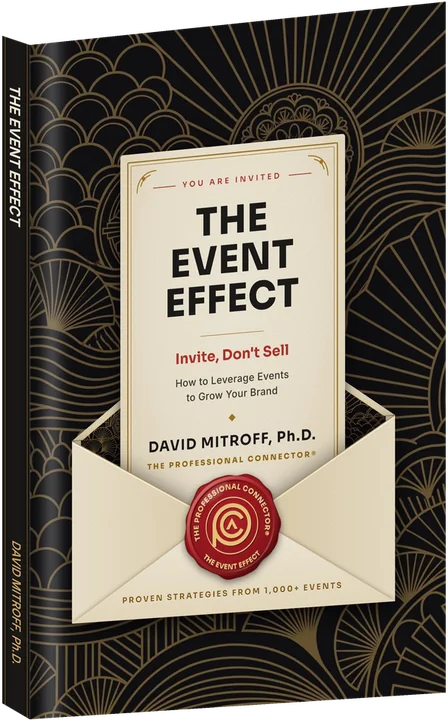
The Event Effect
David wrote the book on events that grow a business. The Event Effect, now in its second edition, covers how to plan, fill, host and follow up on them.
Take action
Your next three steps
- Write down in one sentence what success looks like before you book the room.
- Count follow-up meetings booked, partnerships started and replies to the invitation after each event.
- Track who you invited, who said yes, who sent regrets and who showed up.
In their own words
What clients say about working with us
“McDowall Cotter started working with David Mitroff and right away things started to happen. We have managed to fill up our seminar rooms again, he has found us great new staff to run our marketing department, and business is booming. More than a marketing consultant, he is also a business confidant, helping us keep course on our goal to growth.”
 David RosenbaumPartner, McDowall Cotter, APC

“David was extremely helpful, and the most responsive consultant I’ve ever worked with. If he didn’t know something, he had no problem acknowledging that, and calling in an expert. His follow-up was absolutely impeccable.”
 Judith Szepesi, J.D.Partner, Blakely Sokoloff Taylor & Zafman

Read more client stories or see our case studies.
For David’s rule of thumb on turnout from an evening at the SLS Hotel Beverly Hills, see our page on business consulting in Beverly Hills.
Frequently asked questions
Frequently asked questions
How do you measure the success of a business event?
The success of a business event is best measured by the qualified meetings, partnerships and opportunities the event creates, not by how many people walked through the door.
Is head count a good measure of event success?
No. Head count measures attendance, and a business event succeeds when the right people come and something happens afterward, such as a follow-up meeting, a partnership or a booked private event.
When do I decide how to measure an event?
Decide how to measure an event before you book the room or send an invitation, by writing down in one sentence what success looks like the morning after.
What do I track after every event?
After every event, track who you invited, who said yes, who sent regrets, who showed up and which guests booked a follow-up meeting.
How do I figure the cost per meeting for an event?
Add up everything the event cost, including your team’s time, then divide by the number of follow-up meetings booked with people who fit the room. Compare that figure with what one good client is worth to your business.
How long after an event do I keep measuring results?
Count the follow-up meetings in the first week, then check again at thirty and ninety days, since many partnerships and clients take a few weeks to come from a single room.
Does Piedmont Avenue Consulting, Inc. plan and measure business events?
Yes. Piedmont Avenue Consulting, Inc. plans and measures business events for owners in the San Francisco Bay Area, Los Angeles, Orange County and New York. Schedule a call with David to talk about your next event.
Let’s grow together.
Schedule a call with David. Tell us about your next event, and we will look at how to make the room count.
Or call David at 510-761-5895, 8 AM to 8 PM, seven days a week.
About the author
David Mitroff, Ph.D. wrote this article. He is the founder of Piedmont Avenue Consulting, Inc., a business and marketing consulting firm serving the San Francisco Bay Area, Los Angeles, Orange County and New York. Meet David or read more articles by David.
- Founder and Business Growth Strategist at Piedmont Avenue Consulting, Inc.
- Doctorate in clinical psychology, with additional coursework in business administration, law and culinary arts; bachelor’s and master’s degrees.
- Taught marketing and entrepreneurship at the University of California, Berkeley for more than seven years.
- Author of several books, including The 45 Day Consultant, The 45 Day Consultant Field Guide, Online Business Growth Strategies, The Event Effect: Invite, Don’t Sell, and Law Firm Business Growth Strategies (Second Edition).
- Started seven companies; previously owned and ran a recruiting and staffing company.
David works with a small team of consultants and specialists on every engagement. Meet our team or read about Piedmont Avenue Consulting, Inc.