



A call with David Mitroff, Ph.D.
Talk through your business with David
Quick answer
Thank everyone who registered, including the people who did not come. Send the slides to everyone. Sort the full list and write personal notes to the most important people within one business day. Aim for the next meeting, not the sale. As a guest, follow up within seventy-two hours and thank the host. Then end every note with the next invitation. Piedmont Avenue Consulting, Inc. works with owners across the San Francisco Bay Area, Los Angeles, Orange County and New York on events and the follow-up that turns them into business.
Key takeaways
- David thanks every person who registered, including those who did not come, because opportunities have come from both groups.
- Sending the presentation to every registrant works, since many people register for the slides and one reader even became a client.
- Sorting the full list into five groups, from high priority to not a fit right now, turns names into a plan.
- The job of a follow-up is to get the next meeting, not to close the sale.
Event follow-up is where most of the value of an event is won or lost, and it is the part most hosts rush. At Piedmont Avenue Consulting, Inc., we are a business and marketing consulting firm that works with owners in the San Francisco Bay Area, Los Angeles, Orange County and New York to start, grow and scale their businesses. David Mitroff, Ph.D., has hosted more than one thousand events, and in The Event Effect he writes that the evening itself only creates the opportunity. These are the seven beliefs we hear most about the days after an event, and what he does instead.
Why the days after count more than the night
The room, the food and the speakers get most of the planning. The days after get whatever energy is left. That order is backward.
“Most people think that’s the end. It’s actually the middle.”
David Mitroff, Ph.D., in The Event Effect, Chapter 14: Follow-Up Is Where the Value Is
In the book, David writes that the invitations, the room and the introductions create the opportunity, and follow-up is where you actually get it. A great evening with no follow-up leaves a pleasant memory and little else. An ordinary evening with excellent follow-up can fill the next month with coffees, calls and introductions.
Myth: only thank the people who came
Fact: David sends a thank-you to every single person who registered, within a day or two. The people who came get a warm note, a photo or two and a thank-you to the sponsors and venue. The people who did not come get almost the same note, telling them they were missed and inviting them to the next one.
“They didn’t come, and they were still part of the event.”
David Mitroff, Ph.D., in The Event Effect, Chapter 14: Follow-Up Is Where the Value Is
He writes that opportunities have come from people who showed up and from people who did not, again and again.
Myth: the slides are only for the people in the room
Fact: For a webinar or a workshop, David sends a copy of the presentation to every person who registered, whether they showed up or not. Many people register for exactly that reason.
He writes about a client who read one of his presentations, hired him without ever seeing him speak and then worked with him every month for years. When that client finally came to one of his keynotes, they were surprised by how good it was.
“The presentation did the inviting for me.”
David Mitroff, Ph.D., in The Event Effect, Chapter 14: Follow-Up Is Where the Value Is
Our guide on how to host a webinar people join, talk in and remember covers the rest of the online version.
Myth: one email to the whole list is enough
Fact: The group thank-you is the start. David calls the next step the one almost everyone skips. He gets the complete list of everyone who registered, the walk-ins and every card from the raffle bowl, goes through it name by name and sorts each person into one of five groups:
- High priority, to meet this week.
- Meeting, for coffee or a call this month.
- Nurture, for the newsletter, invitations and an occasional note.
- Future event, for someone who fits an upcoming panel or dinner.
- Not a fit right now, to thank, keep on the list and move on.
The high-priority and meeting groups get a personal note, not a template. The sorting is what turns a list of names into a plan for the week.
How to sort the list without losing a day
- Do it the next morning, while you still remember faces and conversations.
- Start with the cards and notes you collected, then work through the registration list.
- Ask your team or co-hosts who they met and what they promised, so nobody falls through the cracks.
- Decide fast. If you hesitate on a name, put it in nurture and move on.
- Write the next step next to each name, with a date, before you close the list.
Myth: follow up when things calm down
Fact: David’s rule is one business day for the personal notes. Not a week, and not when things calm down. One business day, while the evening is still fresh for both people. Our follow-up system shows how to make that a habit.
Myth: the follow-up is where you make the sale
Fact: David credits the sales author Stephan Schiffman with the idea he still uses.
“The job is not to close the sale. The job is to get the next meeting.”
David Mitroff, Ph.D., in The Event Effect, Chapter 14: Follow-Up Is Where the Value Is
A thank-you note is not trying to sell anyone anything. It is trying to earn a coffee, a call or an introduction. At his executive dinners, David writes, the goal is to book the follow-up call before people leave the table, and if that did not happen, the note the next morning books it.
Hosting an event soon?
Schedule a call with David Mitroff, Ph.D. We look at your guest list and plan the follow-up before the doors open.
Or call David at 510-761-5895, 8 AM to 8 PM, seven days a week.
Myth: follow-up is the host’s job
Fact: Guests follow up too. David’s rule for guests is to follow up with the people they liked within seventy-two hours, with a short note that names where they met and suggests a coffee, and to connect on LinkedIn the same day. Then thank the host.
“Hosts remember the guests who say thank you, and they invite them to the next one.”
David Mitroff, Ph.D., in The Event Effect, Chapter 14: Follow-Up Is Where the Value Is
Our answers for owners who are nervous about networking events cover the evening itself.
Myth: if nothing happens this week, the follow-up failed
Fact: David writes that some follow-ups pay off next week and many pay off much later. A contact who stays in touch and keeps getting invited may make the introduction that matters months after the event. That is what happens when a host keeps inviting people, keeps following up and stays visible long after the night is over.
Plan the follow-up before the doors open
The easiest follow-up is the one you prepared in advance. A little work before the event saves days of scrambling after it.
- Write the thank-you email before the event, with blanks for photos and a line about the evening.
- Set the date of the next event, so every note can end with a real invitation.
- Decide who follows up with whom. If you have co-hosts, a team or sponsors, split the list before the night.
- Block the morning after on your calendar for sorting and personal notes.
- Keep a pen handy at the event, and write one line on the back of every card you collect.
Our questions and answers on how far ahead to plan a business event show where the follow-up fits in the full timeline.
Follow-up for different kinds of events
The principles stay the same. The details change with the room.
- An executive dinner. The group is small, so every guest gets a personal note. Aim to book the next conversation at the table, and use the note the next morning to confirm it. Our guide on how to host an executive dinner covers the evening itself.
- A webinar or workshop. Send the slides to everyone who registered, with a short note and one next step.
- A mixer or open house. The list is long and the conversations are short. Sort carefully, and save personal notes for the people you want to see again.
- A panel. Thank each panelist by name, in public and in private, and share the key points with everyone who registered.
- Someone else’s event. As a guest, follow the seventy-two-hour rule, connect on LinkedIn and thank the host.
What the notes sound like
The notes are short. In the book, David shares the opening of the thank-you he sends to everyone who registered, within a day or two, every time.
“Thank you for being part of last night, whether you were in the room or not.”
David Mitroff, Ph.D., in The Event Effect, Chapter 14: Follow-Up Is Where the Value Is
That note goes on with a few photos, the presentation, a thank-you to the panel and sponsors and the next two events. The guest’s note is shorter still. His example names the event and the day, picks up the conversation the two people started, such as restaurant expansion, and suggests coffee the next week. One line about where you met, one line about what you talked about and one next step is enough.
For the high-priority group, write each note yourself. Mention one thing the person said, and offer one specific next step: a coffee, a call or an introduction to someone in the room. A note like that takes a few minutes, and it reads like it came from a person.
What a good thank-you email includes
David lists what goes into the note he sends after every event:
- Their first name.
- A photo or two, or a note that photos are coming.
- A thank-you by name to the venue, sponsors, speakers and volunteers.
- Any slides or materials that were promised.
- One clear next step: the next event, a short survey or an easy way to book a call.
- An invitation to share a photo or a comment about the evening.
- Your call to action, the reason you held the event in the first place.
And every thank-you ends with what is next. He writes that the best follow-up of all is the next invitation. Our guide on how to host a business event that brings in clients covers the planning that comes before it.
Notes you can adapt
Short notes work best. Here are four you can adjust to your own voice.
To someone who registered and did not come: “Hi Jordan, we missed you last night. Here are a few photos and the slides from the panel. Our next event is the first Thursday of next month, and I’d love to save you a seat.”
To a high-priority guest: “Hi Priya, it was great talking with you last night about opening a second location. I know someone who went through the same lease question and would be glad to compare notes. Would you like an introduction? Coffee next week works too.”
To the venue or a sponsor: “Hi Sam, thank you for making last night possible. The room was full, the food got compliments all evening and several guests asked about the space. Here are a few photos you are welcome to share.”
To the host, as a guest: “Hi Lee, thank you for including me last night. I met two people I plan to follow up with, and I’m grateful for the introductions. If there is someone you want to meet, I’d be glad to return the favor.”
Three hosts, three follow-ups
A dental office open house. The guests are neighbors, patients and nearby business owners. Everyone gets a thank-you with a photo and an easy way to book a visit. Personal notes go to the business owners who came, since they are the people most likely to send new patients.
A law firm workshop. Every registrant gets the slides. Personal notes go to the attendees who asked questions and the referral partners in the room, and the next step is a call about the question each person raised.
A shop’s product launch. Guests get photos and an invitation to the next evening at the shop. Personal notes go to partners, the best customers and anyone who asked about a special order. The note names the item they asked about and offers to set it aside.
In each case, the sorting decides who gets a personal note, and the personal note decides what happens next.
Common follow-up mistakes
- Sending a sales brochure as the thank-you. The note is there to earn a conversation, not to close a deal.
- Writing the same note to everyone. The group thank-you can be shared. The personal notes cannot.
- Waiting for the photos. Send the thank-you on time, and add a line that photos are coming.
- Forgetting the sponsors, venue and volunteers. They decide whether you get the room next time.
- Asking for a meeting with no reason. Name what you talked about and why a coffee makes sense.
- Losing track of the promises. Every “I’ll send you that” from the evening belongs on a list with a date.
“Most business is lost in the follow-up nobody sent.”
David Mitroff, Ph.D., in The 45 Day Consultant (2026 edition), Chapter 3: Becoming the Expert
How to measure follow-up
Head count tells you how the invitations did. Follow-up tells you how the event did.
“Eighty people who drank your wine and left are not a success. Twelve people, three of whom book a follow-up call, are.”
David Mitroff, Ph.D., in The Event Effect, Chapter 4: Start With Why
After each event, track these numbers:
- Personal notes sent within one business day, compared with the size of your high-priority and meeting groups.
- Meetings booked from the event in the following month.
- Introductions made or received because of the event.
- New clients or partners who trace back to the event, including people who registered and did not come.
- Repeat guests at the next event.
Our article on how to tell whether a business event worked goes deeper on the numbers.
The regulars are the real return
“The people who keep coming become your regulars. The regulars become your friends, your partners, your clients and your best promoters.”
David Mitroff, Ph.D., in The Event Effect, Chapter 14: Follow-Up Is Where the Value Is
Follow-up is how a guest becomes a regular. The thank-you invites them back. The personal note gives them a reason to come. The next invitation gives them a date. Over a series of events, the same faces return and start bringing friends. Our comparison of one big event vs. a series of small ones shows how a series builds on itself.
Your follow-up plan for the week after the event
- The night of the event: write a line on each card, and note any promises.
- The next morning: sort the full list into the five groups, and send personal notes to the high-priority and meeting groups.
- Within two days: send the thank-you to everyone who registered, with photos, the slides and the next event.
- By the end of the week: book the coffees and calls, make the introductions you promised and add every name to your tracking system.
- The following month: invite everyone to the next event, and check in with the nurture group.
A spreadsheet works to start. A simple CRM works better once the list grows. Our plain definition of a CRM shows what to track.

How we work with owners on follow-up
We look at your guest list before the event, plan the notes and the sorting, write the thank-you and the personal follow-ups and build the habit that turns each event into meetings. In the first ninety days of working together, our job is to find our fee, which means making or saving you more than you pay us. We start with an initial consultation and a paid assessment, then build a ninety-day plan and a twelve-month marketing calendar. Learn more about our business consulting services.
From David’s books
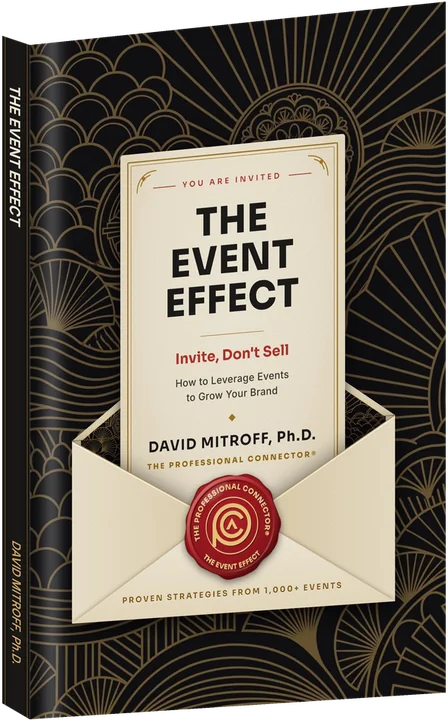
The Event Effect
David wrote the book on events that grow a business. The Event Effect, now in its second edition, covers how to plan, fill, host and follow up on them.
Take action
Your next three steps
- Write personal notes to your most important contacts within one business day of the event.
- End every thank-you note with one clear next step and the next invitation.
- Schedule a call with Piedmont Avenue Consulting, Inc. to plan the follow-up before your next event opens.
In their own words
What clients say about working with us
“McDowall Cotter started working with David Mitroff and right away things started to happen. We have managed to fill up our seminar rooms again, he has found us great new staff to run our marketing department, and business is booming. More than a marketing consultant, he is also a business confidant, helping us keep course on our goal to growth.”
 David RosenbaumPartner, McDowall Cotter, APC

Read more client stories or see our case studies.
Frequently asked questions
Frequently asked questions
Who gets a thank-you email after an event?
David Mitroff, Ph.D., sends a thank-you to every person who registered, including the people who did not come, within a day or two of the event.
How fast do you follow up after a business event?
David Mitroff, Ph.D., writes personal notes to his most important contacts within one business day. As a guest, his rule is to follow up within seventy-two hours.
Do you send the slides to people who missed a webinar?
Yes. David Mitroff, Ph.D., sends the presentation to everyone who registered, whether they showed up or not, because many people register for the slides.
What is the goal of an event follow-up?
The goal is the next meeting, not the sale. A follow-up note aims to earn a coffee, a call or an introduction.
What do you put in a follow-up note after meeting someone at an event?
One line about where you met, one line about what you talked about and one clear next step, such as a coffee, a call or an introduction.
How do you measure event follow-up?
Track the personal notes sent within one business day, the meetings booked in the following month, the introductions made, the new clients or partners who trace back to the event and the guests who return for the next one.
Does Piedmont Avenue Consulting, Inc. plan event follow-up for owners?
Yes. Piedmont Avenue Consulting, Inc. works with owners in the San Francisco Bay Area, Los Angeles, Orange County and New York on events and follow-up. Schedule a call with David to talk about your next event.
Let’s grow together.
Schedule a call with David. Tell us about your next event, and we will plan the follow-up with you.
Or call David at 510-761-5895, 8 AM to 8 PM, seven days a week.
About the author
David Mitroff, Ph.D. wrote this article. He is the founder of Piedmont Avenue Consulting, Inc., a business and marketing consulting firm serving the San Francisco Bay Area, Los Angeles, Orange County and New York. Meet David or read more articles by David.
- Founder and Business Growth Strategist at Piedmont Avenue Consulting, Inc.
- Doctorate in clinical psychology, with additional coursework in business administration, law and culinary arts; bachelor’s and master’s degrees.
- Taught marketing and entrepreneurship at the University of California, Berkeley for more than seven years.
- Author of several books, including The 45 Day Consultant, The 45 Day Consultant Field Guide, Online Business Growth Strategies, The Event Effect: Invite, Don’t Sell, and Law Firm Business Growth Strategies (Second Edition).
- Started seven companies; previously owned and ran a recruiting and staffing company.
David works with a small team of consultants and specialists on every engagement. Meet our team or read about Piedmont Avenue Consulting, Inc.