

Law Firm Growth Guide
Law firm workshops and events that grow the firm through invitations
Piedmont Avenue Consulting, Inc. helps attorneys plan law firm workshops and events that bring in work. The invitation does the marketing, even when the room is small. We work with law firms in New York, Los Angeles, Arizona, the San Francisco Bay Area and wherever you practice.
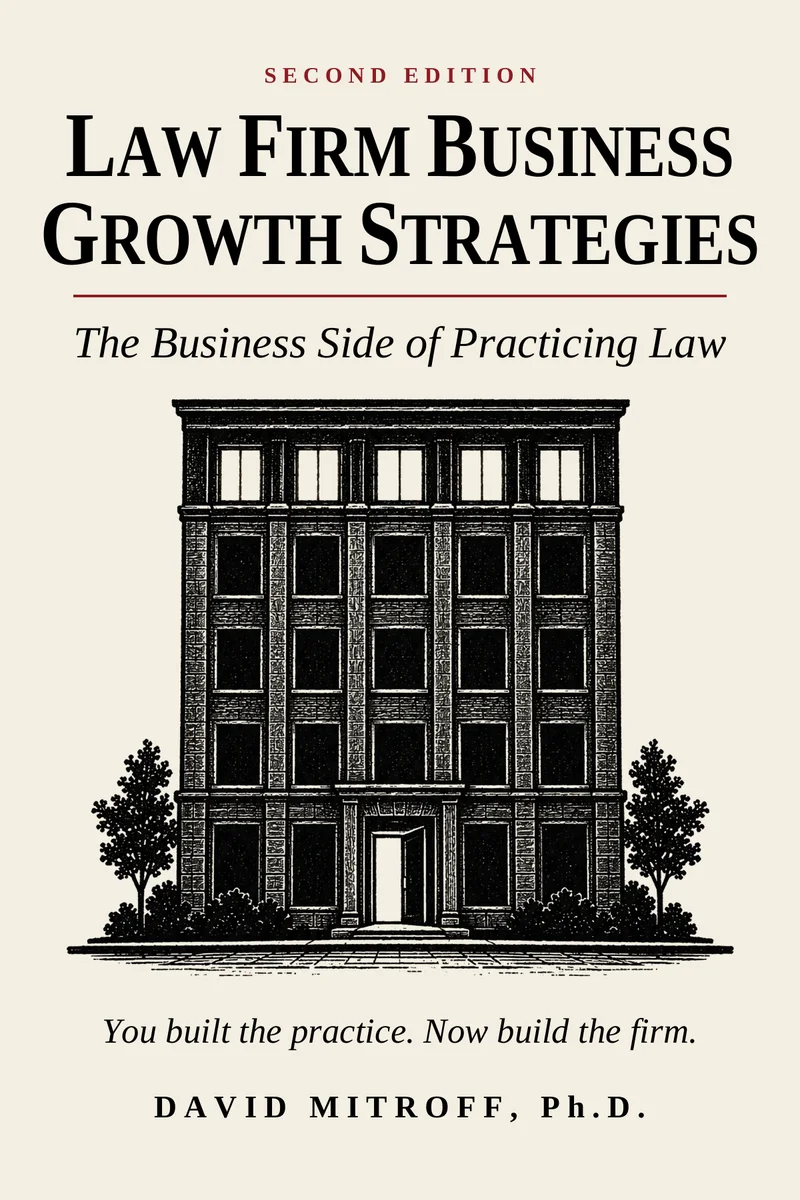
From the book
From the chapter
In the chapter titled “Workshops and Events”, David Mitroff, Ph.D. writes:
“That is the Event Effect in one sentence: hosting an event grows the firm whether or not the room is full, because the invitation puts you in front of everyone you invited, on your subject, as the host.”
From Law Firm Business Growth Strategies, Second Edition, the playbook we bring to every firm we work with.
How firm events work in every market
Many lawyers hold back from hosting because of one fear: what if nobody comes? David Mitroff, Ph.D., who has hosted more than fifty business events a year for well over a decade, says attendance matters less than most people think. If a firm invites three hundred people and twenty come, the other two hundred and eighty still saw an invitation from a lawyer, with a subject, a date and the firm’s name. The invitation is the marketing. The ideas below apply to firms in New York, Los Angeles, Arizona and the San Francisco Bay Area, and to firms wherever their lawyers practice.
The same model in every market
Host small and invite wide. A first event might be a lunch for twelve financial advisors on one change in estate planning this year, a breakfast for a dozen contractors on the contract clauses that lose them money, or a session for human resources directors. Before any event, answer six questions: who will be there, what the theme is, when it happens, what success looks like, what the budget is, and who the partners are. Success means conversations that lead to a next meeting, not a head count. Every co-host, such as an accounting firm, a bank or a trade association, doubles the invitation list.

A San Francisco Bay Area example
In the book, David describes a firm in San Mateo where he helped set up in-person workshops twice a month. Clients, prospective clients and the firm’s strategic partners came to learn about planning, budgeting and what changed that year. The partners spoke too, so each one brought their own clients. A seminar room that had been empty for years filled up and stayed full. For most firms, once a month is plenty, and once a quarter is the minimum the market notices.
Firms that serve startups
A firm that works with startups, in any of these markets, can host a networking night for founders, a session on raising capital, or a talk on forming a company correctly. A founder who drafts everything with online tools hears a lawyer ask three questions the founder did not know to ask, and understands why a lawyer matters without being sold anything.
Office hours for lawyers on the move
Office hours need no room and no lunch. Announce a time you will already be at the office, or at a coffee shop while traveling, and invite people to bring questions on the firm’s subject. Post it, send it in the newsletter and be there. If nobody comes, the announcement still reached the list and still sits online for anyone searching that subject.
The timeline, the follow-up and the rules
Run the timeline: the strategy sixty days out, the announcement forty-five days out, a reminder fifteen days out, a personal note the week of, and a reminder the day before. For an event with no charge, about half of those registered coming is normal. Follow up within a day or two, in writing, with what was covered and an invitation to the next one. Most states limit a lawyer asking a prospective client for work in person or by phone, so whether the firm is in New York, California or Arizona, check the local rules and let the guest ask for the meeting.
In the first ninety days of working together, our job is to find our fee, which means making or saving you more than you pay us. We start with an initial consultation and a paid assessment, then build a ninety-day plan and a twelve-month marketing calendar.
Why firms work with David
David’s law firm work at LexisNexis.
Inside the largest firms
For six years at LexisNexis, David Mitroff, Ph.D. worked with some of the largest law firms in the world and met attorneys across the San Francisco Bay Area. Many of them told him the same thing: I want to start my own firm. They knew how to practice law. What they wanted was everything else: what to offer, how to price, and above all, where the right clients come from. So he helped them open their doors, and he has been growing firms ever since.
Teaching lawyers
David has been an approved California MCLE provider and has delivered more than 300 MCLE workshops, webinars and presentations through Piedmont Avenue Consulting, Inc., LexisNexis, Continuing Education of the Bar (CEB) and the San Francisco Bar Association. He has been featured in California Lawyer magazine.
Wherever you practice
We work with law firms in New York, Los Angeles, Arizona, Orange County and the San Francisco Bay Area, and wherever your firm is located. Our main office is on Piedmont Avenue in Oakland, and we meet by video everywhere else.
Personal injury or patent, a solo office or a large partnership, the business side works the same way. We work with:
- Personal injury
- Patent and intellectual property
- Estate planning
- Elder law
- Family law
- Business and corporate
- Employment
- Real estate
- Bankruptcy
- Criminal defense
- Immigration
- Litigation
“David was extremely helpful, and the most responsive consultant I’ve ever worked with. If he didn’t know something, he had no problem acknowledging that, and calling in an expert. His follow-up was absolutely impeccable.”


Quick self-assessment
Score your law firm
Nine questions on the nine keys from David Mitroff, Ph.D.’s book Online Business Growth Strategies. Tap an answer for each one and watch your score move.
On the blog
Articles that go deeper on this chapter
Questions
Questions firms ask.
What happens if nobody comes to a law firm workshop?
A law firm workshop still works when few people come, because everyone on the invitation list saw the firm's name, subject and date. Some people forward the invitation, and some come next time. The invitation is the marketing, and attendance is a bonus.
Which six questions does a law firm answer before hosting an event?
The six questions cover who will be there and how many, the theme, the date, what success looks like and how to measure it, the budget and any charge, and which partners and sponsors will help spread the invitation to more people.
How does a law firm follow up after an event?
A law firm follows up within a day or two, in writing, with everyone who came and everyone who did not. The note covers what was discussed, one useful idea and an invitation to the next event, so the guest is the one who asks for a meeting.
What is a good first event for a law firm to host?
Host small and invite wide. A first event might be a lunch for twelve financial advisors on one change in estate planning this year, or a breakfast for a dozen contractors on the contract clauses that lose them money. Every co-host, such as an accounting firm, a bank or a trade association, doubles the invitation list. See event marketing.
When does a law firm send invitations for a workshop?
The chapter’s timeline sets the strategy sixty days out, the announcement forty-five days out, a reminder fifteen days out, a personal note the week of the event, and a reminder the day before. For an event with no charge, about half of those registered coming is normal.

Take the next step
Schedule a call with David.
Creative strategies, hands-on implementation, and the personal commitment of a partner invested in your success.
Quotes on this page are from Law Firm Business Growth Strategies, Second Edition by David Mitroff, Ph.D. Header photo: Tony Webster, CC BY 2.0, via Wikimedia Commons.