



A call with David Mitroff, Ph.D.
Talk through your business with David
Quick answer
Start with one city and one customer group, build credibility there before you spend on advertising, adapt your pitch and product to how U.S. buyers decide, and build relationships with local partners, mentors and associations early. Market entry is a relationship problem, not a research one. Piedmont Avenue Consulting, Inc. works with international companies entering the San Francisco Bay Area, Los Angeles, Orange County and New York.
Key takeaways
- The United States behaves like many markets at once, so international companies win one region first, learn what works there, then expand.
- Buying decisions in the United States are spread across many independent local buyers, so plan for many smaller sales instead of one large approval.
- U.S. audiences tend to expect the problem and the result up front, a clear ask and proof in numbers or names.
- The tactics change across countries, while a clear offer, real relationships and steady follow-up still win customers in any country.
Expanding into the U.S. market is one of the biggest steps an international company can take, and the questions come long before the first customer. At Piedmont Avenue Consulting, Inc., we are a business and marketing consulting firm that works with owners in the San Francisco Bay Area, Los Angeles, Orange County and New York to start, grow and scale their businesses. David Mitroff, Ph.D., has worked on programs for the Korean, Greek, Swiss, Turkish, Brazilian, Bulgarian and Chinese governments, mentored founders for Google for Startups and spoken at StartupCon Korea and Startup Stadium. These are the questions founders ask us most.
Where in the United States do we start?
Start with one region, not the whole country. The United States behaves like many markets at once, each with its own buyers, networks and pace. Pick the city where your first customers, partners or investors already gather. For technology and startups, that often means the San Francisco Bay Area. For entertainment, consumer brands and trade, Los Angeles and Southern California. For finance, media and fashion, New York.
Win one region, learn what works there, then expand. Our guide on how to break into a new city or market walks through the first ninety days.
How do we choose between the San Francisco Bay Area, Los Angeles and New York?
Choose the city where the first year’s work will happen most naturally. Each region has its own buyers, its own pace and its own calendar of events. David puts it plainly in The Event Effect, writing about the many cities where he has hosted events:
“Each one has its own vibe, its own crowd and its own calendar. What fills a room in San Francisco on a Tuesday may not work in Irvine.”
David Mitroff, Ph.D., in The Event Effect, Chapter 18: What Events Cost
Work through these questions with your leadership team before you book the first trip:
- Where are your first ten customers? Name real companies or customer types, then look at where they are based.
- Where are your partners? Distributors, integrators, agencies and advisors who already serve your buyers.
- Where are your investors, if you plan to raise money in the United States?
- Where do your industry’s associations and conferences meet? A region with an active community gives you rooms to walk into from the first month.
- Which time zone works with home? A team that has to meet across the day every week will feel the difference.
- Who on your team can be there in person, and how often?
If two cities score the same, pick the one where you already have at least one warm relationship. A single trusted introduction is worth more than a perfect market report.
Plan for a second city later
Write down which region comes second and what would have to be true before you go there, such as a steady flow of customers in the first city and a local testimonial you can share. That keeps the team focused now without losing sight of the larger plan.
What surprises international companies most?
How local the United States is. A decision that one national office makes in many countries is spread across thousands of independent buyers here. David describes it this way in The 45 Day Consultant:
“For example, unlike countries where a single Ministry of Education can approve a product for nationwide use, in the U.S. you may need to approach hundreds of independent school districts.”
David Mitroff, Ph.D., in The 45 Day Consultant, Chapter 28: Global Consulting Practices
The same pattern holds in construction, health care and other highly localized industries. Plan for many smaller sales, not one large approval.
How do we build credibility when nobody knows us here?
U.S. buyers want to see proof from people like them. A strong reputation at home is a start, and it rarely transfers on its own. The companies that build trust fastest:
- Publish and speak in the U.S. market: articles, panels and talks in the industry you want to serve. Our guide on how to become an industry expert explains how.
- Earn local testimonials early, even from a small pilot customer.
- Show up in person at industry events, chambers of commerce and associations. Our article on whether face-to-face meetings still matter covers what the research says.
- Borrow trust from partners who already serve your buyers. Our definition of a strategic partner shows how those relationships work.
How do we build a guest list in a market where we know no one?
Start with the people, not the pitch. David describes his own approach to entering a new market this way:
“When I want to break into a new market, I don’t start with a pitch. I start with a guest list.”
David Mitroff, Ph.D., in The Event Effect, Chapter 9: Your Invitation List
For an international company, that list can come together faster than you expect:
- Connect on LinkedIn with the decision-makers, partners and association leaders in your first city, with a short, personal note that says why.
- Ask your home network who they know in that city: customers, investors, alumni and former colleagues.
- Ask your government trade office or chamber for introductions to companies in your industry.
- Attend two or three industry gatherings and write down everyone you meet.
- Invite them all to something small, such as a lunch, a tasting or a panel, as your guest.
Your list is the most valuable asset you will build in the first year. Keep it in one place, note how you met each person and add to it every week.
How do we ask for introductions in a new country?
Ask for introductions, not endorsements. Someone who just met you may hesitate to recommend you, and still be glad to connect you with one person who would find you interesting. David describes how light the ask can be:
“They don’t need to endorse you, just a simple message like, “Hey, I just met this person who works with a lot of lawyers. Thought it might be worth connecting you two.” That’s it. No pressure, no expectations.”
David Mitroff, Ph.D., in The 45 Day Consultant, Chapter 6: How to Attract Customers
Make it easy. Send a short paragraph about your company that the other person can forward, name the kind of person you would like to meet and thank them whatever happens. Our guide on asking for introductions instead of referrals gives the exact words.
Does our pitch need to change?
Usually, yes. Founders from abroad often ask us how to create pitch decks and investor materials aligned with U.S. expectations. U.S. audiences tend to expect the problem and the result up front, a clear ask and proof in numbers or names. A long company history before the offer loses the room.
Your product may need to change too: packaging, pricing, language, payment options and customer service hours all affect how U.S. customers respond.
A pitch outline that works for U.S. audiences
- The problem, in one or two sentences, in the words your customer uses.
- The result, with a number or a named example if you have one.
- How it works, briefly, with one picture or demonstration.
- Proof, such as customers, pilots, partners, press or awards.
- The ask, clear and specific: a meeting, a pilot, an introduction or an investment.
- Your company’s story, last, and short.
What to change in your website and materials
- Write for a U.S. reader. Use plain American English and replace terms that only make sense at home.
- Show local proof as soon as you have it. A testimonial from a U.S. customer, even a small one, matters more than a long list of awards abroad.
- Make the next step obvious. Every page, deck and email ends with one clear action, such as booking a call. Our article on why every message needs a call to action explains why.
- List a way to reach you in U.S. hours, so a buyer does not wait a day for an answer.
Planning your U.S. launch?
Schedule a call with David Mitroff, Ph.D. We look at your product, your first U.S. market and the relationships to build first.
Or call David at 510-761-5895, 8 AM to 8 PM, seven days a week.
Is business really that different in the United States?
The tactics change. The fundamentals hold.
“The principles of value creation, client engagement, and measurable outcomes apply universally.”
David Mitroff, Ph.D., in The 45 Day Consultant, Chapter 28: Global Consulting Practices
Language, time zones and business etiquette add work. A clear offer, real relationships and steady follow-up still win customers in any country.
How do we build a network in a new country?
Treat networking as the main strategy, not a side activity. Find two or three groups where your buyers gather, attend consistently and introduce yourself as someone who gives value first. Host a small event once you know the room: a panel on your industry, a dinner for potential partners or an open house for your new office. Our guides on business networking tips and how to host a business event cover both.
Mentors and advisors who know the U.S. market shorten the learning curve. Our definition of a personal advisory board shows how to build one.
Do we host an event before we have customers?
Often, yes. A small, well-chosen event gives you a reason to reach out to people who would ignore a sales email. A European government delegation once asked David to bring them together with senior fintech leaders in San Francisco over lunch. Their first worry was the one everyone has: what if the right people cannot come? Here is David’s answer.
“An executive who cannot make the date, and takes the time to say so, has just told you the topic matters to them.”
David Mitroff, Ph.D., in The Event Effect, Chapter 1: Invite, Don’t Sell
That reply becomes a call or a meeting at a better time. The event does its work even for the guests who do not attend. Our story on inviting instead of selling tells the rest of that lunch.
A few formats that suit a new arrival:
- A small lunch or dinner for senior people in one industry, with one good conversation topic.
- A panel with local voices and one speaker from your company.
- An open house for a new office or showroom.
- A tasting or demonstration that lets guests experience the product in person.
How do we work across time zones and languages?
The book lists language and time zone barriers among the first things to plan for, and recommends building a team to bridge them.
- Name one person who owns the U.S. market, with authority to make decisions in U.S. hours.
- Set a fixed weekly meeting between the U.S. lead and the home team.
- Plan regular visits, and put them on the calendar for the whole first year.
- Hire or partner locally for the roles that need to be in the room, such as sales, partnerships and events.
- Keep the brand consistent across both languages, so customers recognize you in either market.
What do the first ninety days look like?
Plan the first ninety days around learning and relationships, not revenue targets. Here is one way to lay them out:
- First month: listen and map. Meet partners, advisors and potential customers. Join two or three associations. Build your guest list.
- Second month: show up. Attend the same groups again. Speak or sit on a panel if you can. Host your first small event.
- Third month: earn proof. Land a pilot customer, ask for a testimonial and write down what you learned about how U.S. buyers decide.
At the end of the ninety days, review what worked and set the plan for the rest of the year. Our page on global markets describes how we support international companies through each stage.
What mistakes do international companies make most?
- Trying to launch nationally on day one. The budget spreads thin and nobody hears the message.
- Leading with the company history. U.S. buyers want the problem and the result first.
- Relying on reputation from home. It opens a door, and local proof keeps it open.
- Spending on advertising before building relationships. Ads work better once people already know your name.
- Visiting once and going quiet. Consistent presence over months builds the trust that a single trip cannot.
- Leaving legal and tax questions for later. Formation, contracts and visas take time and shape every other decision.
How do we know the U.S. launch is working?
Track the signs that come before revenue, so you can see progress early:
- New relationships added to your list each month.
- Introductions received from partners and advisors.
- Meetings booked with potential customers.
- Pilots or first orders signed.
- Testimonials and case studies earned in the U.S.
- Invitations to speak, write or join a panel.
When those numbers grow month after month, revenue tends to follow.
What about legal, tax and immigration questions?
Bring in qualified attorneys and accountants early, in the United States and at home. Company formation, contracts, employment, taxes and visas all carry rules that vary by state and by situation. We work alongside your advisors on the market side: positioning, marketing, partnerships and events.
Does this work in the other direction, for U.S. companies going abroad?
Yes. The same principles apply in both directions. A U.S. company entering another country needs local partners, an understanding of cultural and legal differences, marketing that fits local expectations and a team that can bridge language and time zones, while keeping the brand consistent.

How we work with international companies
We choose the first U.S. market with you, adapt the message and materials for U.S. buyers, map the associations, partners and events that matter, and build a calendar of introductions and visibility for the first year. We start with an assessment, agree on the priorities that matter most, and define what success looks like, then build a 90-day plan for ongoing work. We start with an initial consultation and a paid assessment, then build a ninety-day plan and a twelve-month marketing calendar. Learn more about our business consulting services.
From David’s books
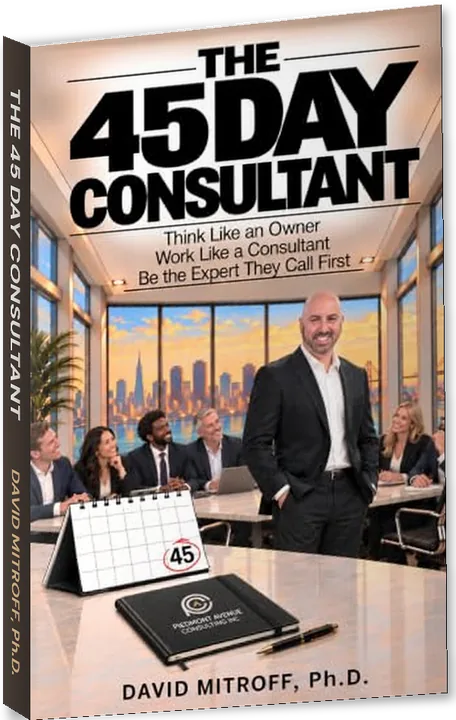
The 45 Day Consultant
This is also in David’s book, The 45 Day Consultant, in the chapter “Global Consulting Practices”.
Read the topic guideAll topics from the bookGet the book on Amazon
Take action
Your next three steps
- Pick the one city where your first customers, partners or investors already gather.
- Earn local testimonials early, even from a small pilot customer.
- Bring in qualified attorneys and accountants early for formation, contracts, taxes and visas.
In their own words
What clients say about working with us
“Right away things started to happen. We have managed to fill up our seminar rooms again, he has found us great new staff, and business is booming. More than a marketing consultant, he is also a business confidant […]”
 David RosenbaumPartner, McDowall Cotter, APC

“David was extremely helpful, and the most responsive consultant I’ve ever worked with. If he didn’t know something, he had no problem acknowledging that, and calling in an expert. His follow-up was absolutely impeccable.”
 Judith Szepesi, J.D.Partner, Blakely Sokoloff Taylor & Zafman

Read more client stories or see our case studies.
Frequently asked questions
Frequently asked questions
How does an international company enter the U.S. market?
An international company enters the U.S. market by starting in one city and one customer group, building local credibility and partnerships before spending on advertising, and adapting the pitch and product to how U.S. buyers decide.
Which U.S. city is best for an international company to start in?
The best U.S. city for an international company is the one where its first customers, partners or investors already gather, such as the San Francisco Bay Area for technology, Los Angeles for consumer brands and trade, or New York for finance and media.
Why is the U.S. market harder to enter than expected?
The U.S. market is harder to enter than expected because buying decisions are spread across many independent local buyers, such as school districts or regional companies, instead of one national approval.
Do international companies need a new pitch deck for U.S. investors?
International companies often adapt their pitch deck for U.S. investors, putting the problem, the result, the ask and the proof up front instead of a long company history.
Does an international company need to be in the United States in person?
In-person presence builds trust faster. Plan regular visits, attend the same industry groups consistently and host small events, with one person who owns the U.S. market and can decide in U.S. hours.
What does an international company do in its first ninety days in the U.S. market?
Spend the first month meeting partners, advisors and potential customers, the second month showing up at the same groups and hosting a first small event, and the third month earning a pilot customer and a testimonial.
How does a company build a network in a U.S. city where it knows no one?
Build a guest list first: connect with decision-makers and association leaders, ask your home network and trade office for introductions, attend industry gatherings and invite the people you meet to a small lunch, tasting or panel as your guests.
Does Piedmont Avenue Consulting, Inc. work with international companies?
Yes. Piedmont Avenue Consulting, Inc. works with international companies on market entry, positioning, partnerships and events in the San Francisco Bay Area, Los Angeles, Orange County and New York. Schedule a call with David to talk about your business.
Let’s grow together.
Schedule a call with David. Tell us which U.S. city you are considering, and we will look at the first relationships to build there.
Or call David at 510-761-5895, 8 AM to 8 PM, seven days a week.
About the author
David Mitroff, Ph.D. wrote this article. He is the founder of Piedmont Avenue Consulting, Inc., a business and marketing consulting firm serving the San Francisco Bay Area, Los Angeles, Orange County and New York. Meet David or read more articles by David.
- Founder and Business Growth Strategist at Piedmont Avenue Consulting, Inc.
- Doctorate in clinical psychology, with additional coursework in business administration, law and culinary arts; bachelor’s and master’s degrees.
- Taught marketing and entrepreneurship at the University of California, Berkeley for more than seven years.
- Author of several books, including The 45 Day Consultant, The 45 Day Consultant Field Guide, Online Business Growth Strategies, The Event Effect: Invite, Don’t Sell, and Law Firm Business Growth Strategies (Second Edition).
- Started seven companies; previously owned and ran a recruiting and staffing company.
David works with a small team of consultants and specialists on every engagement. Meet our team or read about Piedmont Avenue Consulting, Inc.