


A call with David Mitroff, Ph.D.
Talk through your business with David
Quick answer
A large share of the people at a networking event are new, and many came by themselves. The host who greets them, introduces them to one person and makes it easy to come back builds a following that lasts for years. Plan the door, the first introduction and the next invitation around the guest who came alone, and everyone else in the room benefits too.
Key takeaways
- About a quarter of the guests at David’s events have lived in the area for a month or less, and many come alone.
- The guest who came alone has the hardest night in the room and the most to gain from a good one.
- A host who greets people by first name or waves them over tells a newcomer that they were expected.
- A guest welcomed in their first month remembers the host for years and often becomes the person who welcomes the next newcomer.
Welcoming guests at an event starts with one person: the guest who walked in alone, does not know anyone and may be new to the city. At Piedmont Avenue Consulting, Inc., we are a business and marketing consulting firm that works with owners in the San Francisco Bay Area, Los Angeles, Orange County and New York to start, grow and scale their businesses. When we plan an event with an owner, we plan it for that guest first. Here is why.
A bigger share of the audience than you think
In The Event Effect, David Mitroff, Ph.D., writes that about a quarter of the guests at his events have lived in the area for a month or less. Many come alone. Some are still getting comfortable with English. Almost all of them came hoping to meet someone new.
At the monthly workshops he ran at Google, he started by asking the room how many people had just moved there or started a new job and needed to meet people. Usually, somewhere between a quarter and forty percent of the room raised their hands.
That is who is standing next to you at the bar.
“You’re the first welcome some people have had in a new city.”
David Mitroff, Ph.D., in The Event Effect, Chapter 12: The Day of the Event
Who that guest might be
Picture the people who walk in alone. In the book, David describes the ones he meets all the time. One is someone who is sixty and just started a business after a long career. Another is someone who is forty and was told by a friend to “get out there.” Add a few more to that list:
- The new hire who moved for a job and knows only the people on their team.
- The founder who just signed a lease and wants to meet other owners nearby.
- The professional who changed fields and needs a fresh set of contacts.
- The partner or spouse who followed someone else’s job to a new city and wants a life of their own there.
They want to come. They are also a little nervous. Most of them carry the same small worries into the room:
- Will anyone talk to me?
- Where do I stand?
- Am I dressed right?
- Will someone try to sell me something the minute I arrive?
- Can I leave early without it being awkward?
Every part of the plan below answers one of those questions before the guest has to ask it.
Why we plan for that guest first
Most hosts plan for the guests they already know: the clients, the partners, the regulars. Those guests will have a good night either way. They know where to stand and who to talk to.
The guest who came alone has the hardest night in the room, and the most to gain from a good one. When the host gets that guest’s evening right, the regulars notice. They see a room where people are welcomed, and that is the room they invite their friends to.
“The guest who felt welcome at your event in their first month remembers you for years.”
David Mitroff, Ph.D., in The Event Effect, Chapter 12: The Day of the Event
Before the event: the invitation and the phone call
The welcome starts days before the door opens. It starts on the event page.
Answer the questions a first-timer has
David’s event pages carry a short set of answers for the person who is new to all of this. You can borrow the same structure for your own:
- What is it like? A relaxed evening. People get a drink, find a few friendly faces and talk. Nobody gives a hard pitch.
- Who will be there? Business owners, professionals and people new to the area, and plenty of them come alone.
- What do I wear? Business casual. In the book’s words, dress the way you would like to be remembered.
- What do I bring? Business cards if you have them, a pen and a phone.
- What can I expect? A warm welcome at the door, a few introductions from the host and a short welcome. Stay as long as you like.
That last line matters more than it looks. “Stay as long as you like” tells a nervous guest that leaving after twenty minutes is perfectly all right, which makes it far more likely they will come at all.
Put your face on the invitation
David puts a large photo of himself on every event page, newsletter and invitation, with his contact details next to it. Guests who come alone often walk straight up to him because they already know who the host is. For a nervous guest, knowing one face in the room before arriving changes the whole evening. Our guide on how to promote an event covers the rest of what goes on the page.
Take the phone call
Even with all of that on the page, some first-timers still call. They want to know what the evening is really like. David treats those calls as a gift:
“I walk them through the evening, tell them where to find me when they arrive, and promise to introduce them to someone in the first ten minutes. Then I do it.”
David Mitroff, Ph.D., in The Event Effect, Chapter 10: Promotion That Feels Like an Invitation
Write down the name of every caller. When they arrive, you already have your first introduction to make.
What it looks like at the door
The welcome starts before the guest says a word. David’s check-in asks for a first name, not a spelling of a full name and company to a stranger with a clipboard. Then the team shows each guest the way in: where the bar is and where the host is standing.
When someone he invited walks in, he goes to greet them. When he cannot get there right away, he catches their eye and waves them over. It sounds like nothing, and to the person walking in alone, it says that they were expected.
“Go to people. Wave them over. Make everyone feel expected.”
David Mitroff, Ph.D., in The Event Effect, Chapter 12: The Day of the Event
The check-in script
David’s team binder gives everyone who works the door one page. Here is what is on it:
- Arrive thirty minutes before the doors open.
- Print the guest list sorted by first name, because people give you their first name.
- Ask for a business card for the raffle drawing. It is fun, and it gives you contact details for walk-ins who did not register.
- Show each guest the way in and where to find the drinks.
- Welcome walk-ins warmly. “We have tickets at the door.” Then add them to the sign-up sheet.
The book gives the line to use at the door: “The bar’s on the left, and David’s right over there.” Swap in your own name. One sentence like that saves a newcomer from standing frozen in the doorway.
The first thirty minutes
The first guests walk into a quiet room, and that is when the host matters most. When the first people arrive, David tells them, “Great, people are just starting to get here,” so nobody wonders where everyone is. Then he asks where they live, what brought them and how they found the event.
His greeting works for every guest, new or returning.
“I greet everyone with “Nice to see you,” not “Nice to meet you.” It works whether we have met or not.”
David Mitroff, Ph.D., in The Event Effect, Chapter 20: Producing the Event
As each new person walks in, introduce them to the small group already there. Once five or six people are talking, move on and start the next group. A guest who arrives alone in that first half hour becomes part of a circle within minutes, and nobody had to break into one.
Hosting an event soon?
Schedule a call with David Mitroff, Ph.D. We look at your guest list and plan the welcome before the doors open.
Or call David at 510-761-5895, 8 AM to 8 PM, seven days a week.
What it looks like at the event
David watches the edges of the room for the person standing alone near the wall. He walks over, says hello, asks where they are from and introduces them to someone they would enjoy meeting. Then he leaves them to it. Our point of view on hosting the room instead of working it covers that move in full.
The invitation does some of the work too. His event descriptions include a short set of answers for the person who is new to all of this: what the evening is like, who will be there, what to wear and what to bring. One answer tells newcomers that plenty of guests are coming alone and plenty are coming for the first time.
“The first event is the hard one. Make it easy, and they keep coming back.”
David Mitroff, Ph.D., in The Event Effect, Chapter 10: Promotion That Feels Like an Invitation
Read the room
A lot of hosting is paying attention. The book lists four things to watch:
- The edges. People alone at the edges of the room want someone to come get them.
- The circles. A closed circle is deep in conversation, so leave it be. A circle with an open side is inviting someone in, so bring someone over.
- The energy. If the room goes quiet, it is time for the welcome or the panel. If it is loud and happy, let it run.
- The clock. Start the program on time, keep it short and end on time.
The introduction, word for word
A good introduction gives two strangers a reason to keep talking after you leave. The book’s example sounds like this: “Sarah, this is James. He just opened a restaurant in Oakland, and you were telling me you’re looking for a caterer.” A name, one fact and one reason. Then step away.
“That’s the whole move: notice, welcome, introduce, step away.”
David Mitroff, Ph.D., in The Event Effect, Chapter 12: The Day of the Event
To make that work, ask each new guest one or two easy questions at the door, such as where they live and what brought them. You now have the fact and the reason for their first introduction. Our business networking tips offer more questions that open a conversation without a pitch.
Your team hosts too
You cannot greet every guest yourself at a larger event. Everyone working it is a host: staff, volunteers, interns and partners. Before the doors open, walk through the evening together and cover:
- Where each person stands and what each one is responsible for.
- How to greet people and where to send them.
- What to say when a guest asks, “So what do you do here?”
- What to do when a guest tries to hire them on the spot: warmly take a card and bring it to the host.
- Who watches the edges for the guest standing alone.
“A team that knows the plan is relaxed. A relaxed team makes a relaxed room.”
David Mitroff, Ph.D., in The Event Effect, Chapter 12: The Day of the Event
In David’s company, working events is part of every new team member’s first weeks. Give each new person one small job at their first event and a bigger one at the next. By the third event, they are introducing guests. By the tenth, they are running the door and spotting the person by the wall before anyone else does. Our event day checklist lays out every role from the door to the last goodbye.
What it builds
The guests who came alone to David’s workshops did not stay strangers. Many became regulars. Some started bringing friends and introducing newcomers to each other. A guest who was welcomed in their first month becomes the person who welcomes the next one.
That is the return on a warm door. It does not show up on the night itself. It shows up a year later, in the regular who brings three colleagues, makes an introduction or remembers who made them feel at home. Our story about the January party behind The Event Effect shows where that feeling started for David.
The morning after
The welcome is only half done when the room empties. A first-timer decides whether to come back based on what happens next.
- Send the thank-you the next morning. Keep it short and warm.
- Name the person you introduced them to. “I hope you and James found a time to talk about catering.” It shows you remember them.
- Include the next event. List one or two upcoming dates, no more. The book warns that six future dates lead people to choose “some other month.”
- Skip the pitch. A sales email the morning after tells a newcomer the welcome had a price.
- Write to the people who registered and did not come. They still saw your invitation, and they will be glad to hear from you.
Our article on event follow-up myths covers the beliefs that waste that morning.
The same idea at different kinds of events
The guest who came alone shows up at every kind of business event. Here is what the welcome looks like in a few settings.
- A law firm workshop. Seat a firm member at each table to make introductions before the talk begins, so the owner who came alone has a name to follow up with.
- A dental practice open house. Have one team member greet each family at the door and walk them through the space, so nobody wanders the hallway wondering where to go.
- A restaurant tasting night. Ask the host stand to seat solo guests at a shared table near the bar and introduce them to their neighbors.
- A contractor’s site tour. Pair each new guest with someone from the team who can explain what they are looking at and introduce them to the architect or owner.
- A retail shop’s evening event. Station someone near the entrance with a tray and a friendly question about what brought each guest in tonight.
Common mistakes that leave a newcomer standing alone
- The host spends the night with friends. The regulars feel at home, and the newcomer watches from the wall.
- Check-in turns into a quiz. Asking for a full name, company and spelling at the door feels like a security line.
- Nobody points the way in. A guest who does not know where to stand often leaves within minutes.
- The program runs long. A short welcome respects the evening. A long one traps the people who came to meet others.
- Introductions without a reason. “You two ought to meet” with nothing else leaves both people searching for a topic.
- A follow-up that sells. The fastest way to lose a first-timer is to treat the welcome as the start of a pitch.
How to tell whether the welcome is working
Head count says little about the guest who came alone. A few simple numbers say much more, and our guide on how to measure event success covers them in full:
- First-timers per event. Ask at check-in, or mark them on the guest list.
- First-timers who return within the next two or three events.
- Introductions made by the host and team during the evening.
- Regulars who bring a friend, a sign that the room feels welcoming to them too.
- Regulars who start introducing others, the clearest sign of all.
Track these on the same sheet you use for the guest list. After a few events, you will see which welcomes turn first visits into habits.
What we tell owners to do
- Write the invitation for a first-timer. Say what the evening is like and that many guests come alone.
- Staff the door. Greet by first name and point the way in.
- Watch the edges. Introduce the guest standing alone to one person, then step away.
- Brief your team. Everyone working the event is a host.
- Invite them back. The note the next morning, and the next invitation, turn a first visit into a habit. Our follow-up system shows how.
What to do this week
- Add a five-question first-timer section to your next event page.
- Put your photo and contact details on the invitation.
- Write a one-page check-in script for whoever works the door.
- Pick one team member whose only job is to watch the edges of the room.
- Draft the morning-after note now, with a blank for the name of the person each guest met.

How we work with owners on events
We look at who you want in the room, write the invitations, plan the door and the introductions and build the follow-up that turns first visits into regulars and regulars into clients. In the first ninety days of working together, our job is to find our fee, which means making or saving you more than you pay us. We start with an initial consultation and a paid assessment, then build a ninety-day plan and a twelve-month marketing calendar. Learn more about our business consulting services.
From David’s books

The 45 Day Consultant Field Guide
This is also in David’s book, in Chapter 14, “How Leaders Create Luck”. Each chapter page sums up the idea, the story behind it and what to do next.
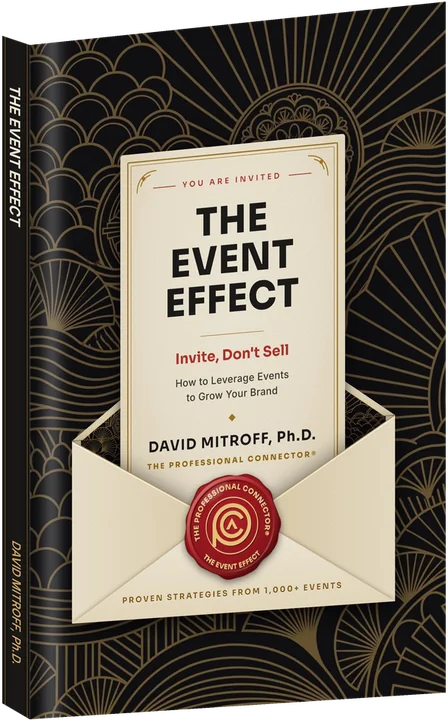
The Event Effect
David wrote the book on events that grow a business. The Event Effect, now in its second edition, covers how to plan, fill, host and follow up on them.
Take action
Your next three steps
- Write the invitation for a first-timer, saying what the evening is like and that many guests come alone.
- Watch the edges of the room, introduce the guest standing alone to one person, then step away.
- Schedule a call with Piedmont Avenue Consulting, Inc. to plan the welcome before your next event.
In their own words
What clients say about working with us
“McDowall Cotter started working with David Mitroff and right away things started to happen. We have managed to fill up our seminar rooms again, he has found us great new staff to run our marketing department, and business is booming. More than a marketing consultant, he is also a business confidant, helping us keep course on our goal to growth.”
 David RosenbaumPartner, McDowall Cotter, APC

“David was extremely helpful, and the most responsive consultant I’ve ever worked with. If he didn’t know something, he had no problem acknowledging that, and calling in an expert. His follow-up was absolutely impeccable.”
 Judith Szepesi, J.D.Partner, Blakely Sokoloff Taylor & Zafman

Read more client stories or see our case studies.
Frequently asked questions
Frequently asked questions
How many guests at a networking event are new to the area?
David Mitroff, Ph.D., writes that about a quarter of the guests at his events have lived in the area for a month or less, and many come alone.
How do you welcome a guest who comes to an event alone?
Greet the guest by first name at the door, show the way in, then introduce the guest to one person and step away.
What goes in an invitation for first-time guests?
Say what the evening is like, who will be there, what to wear and what to bring, and mention that many guests come alone.
Why plan an event around newcomers?
Guests who feel welcome in their first month remember the host for years, and many become regulars who bring friends.
What do you say to the first guests when the room is still empty?
Tell them, “Great, people are just starting to get here,” so nobody wonders where everyone is. Then ask where they live and what brought them, and introduce each new arrival to the group.
How do you train a team to welcome guests at an event?
Walk through the evening before the doors open: where each person stands, how to greet people, where to send them and what to do when a guest asks about the business. Give new team members one small job at their first event and a bigger one at the next.
What do you send a first-time guest after the event?
Send a short thank-you the next morning, name the person you introduced them to and include one or two upcoming dates. Leave out the sales pitch.
Does Piedmont Avenue Consulting, Inc. plan networking events for owners?
Yes. Piedmont Avenue Consulting, Inc. works with owners in the San Francisco Bay Area, Los Angeles, Orange County and New York on events, invitations and follow-up. Schedule a call with David to talk about your next event.
Let’s grow together.
Schedule a call with David. Tell us about your next event, and we will plan the welcome with you.
Or call David at 510-761-5895, 8 AM to 8 PM, seven days a week.
About the author
David Mitroff, Ph.D. wrote this article. He is the founder of Piedmont Avenue Consulting, Inc., a business and marketing consulting firm serving the San Francisco Bay Area, Los Angeles, Orange County and New York. Meet David or read more articles by David.
- Founder and Business Growth Strategist at Piedmont Avenue Consulting, Inc.
- Doctorate in clinical psychology, with additional coursework in business administration, law and culinary arts; bachelor’s and master’s degrees.
- Taught marketing and entrepreneurship at the University of California, Berkeley for more than seven years.
- Author of several books, including The 45 Day Consultant, The 45 Day Consultant Field Guide, Online Business Growth Strategies, The Event Effect: Invite, Don’t Sell, and Law Firm Business Growth Strategies (Second Edition).
- Started seven companies; previously owned and ran a recruiting and staffing company.
David works with a small team of consultants and specialists on every engagement. Meet our team or read about Piedmont Avenue Consulting, Inc.