

Field Guide, Chapter Nine
Value-based pricing for small businesses
Clients do not buy your time. They buy what changes for them. This page compares two ways to agree on work and shows which one holds.
The short answer
Value-based pricing means you charge for the result a client gets, not for the hours you spend. You agree on that result together first, in a service agreement, so the price has an exact thing to cost. Piedmont Avenue Consulting, Inc. helps owners in the San Francisco Bay Area, Los Angeles, Orange County and New York price, scope and grow their work this way.
From The 45 Day Consultant Field Guide
In the chapter titled “Price the Result, Not the Hours,” David Mitroff, Ph.D. writes:
“A proposal is often a shot in the dark, based on assumptions, guesswork, and hope. It’s a static document trying to predict a dynamic conversation.”
A proposal guesses at what the client wants before you have really talked. Talk first, agree on the result, and then the price makes sense to both sides.
 (opens in a new tab)
Get the book on Amazon (opens in a new tab)
See every chapter
Two ways to start
Proposal or service agreement?
Proposal
- How the work starts
- You guess what the client wants and write a document alone.
- What the client does
- Takes the document away and compares the offer with two or three others.
- What the price is based on
- Assumptions, guesswork and hope.
- Negotiation
- Common, because the number was a guess and now the client wants the number lower.
- When the scope moves
- The change gets absorbed in silence, or turns into a whole new contract.
Service agreement
- How the work starts
- You sit down together and map out what the client actually wants.
- What the client does
- Helps build the agreement, so both sides can say the goal the same way.
- What the price is based on
- An exact scope that both sides clarified and agreed on.
- Negotiation
- Rare, because the work was clarified before anyone named a number.
- When the scope moves
- A short new scope of work goes under the same master service agreement.
David uses service agreements, because a real conversation first makes the price clear and makes the agreement hold.
“When work is scarce you get less selective and you charge less, and the calendar fills with clients you would not have chosen. When work is plentiful you get more selective and you charge more, and the calendar fills with the clients you wanted.”
Charge for outcomes
What value-based pricing means
In the book, David points to Alan Weiss, who wrote one of the best-known books on this subject, Value-Based Fees. David does not summarize the method. He shares the idea he took from the book and built on in his own way: clients pay for what changes for them. You earn by helping them grow, solve problems, save time or make money.
He names three things to think about when you set a price. The first is the scope of services: a strategy, help with doing the work, or open access for advice. The second is access and availability, such as weekend or after-hours time, because charging for access sets boundaries. The third is the level of impact. A change that transforms a business is worth much more than a fix for a small problem.
Some callers start with one question: how much? David does not talk about money until it makes sense, or until they ask three times. Then he gives a range so wide that people stop and laugh. He explains that he has not been able to ask his questions yet. Once he asks them, he can give a real number, and most people agree to start there.
This is not only for consultants. The chapter says that inside a company, somebody prices what the company sells, and often that person is you. A project manager who cannot say what the work is worth loses the argument about the deadline. When you talk about your own pay, the skill is the same: know what the work is worth, and say so in one sentence.
From the chapter
A pricing story from a grocery store owner
David tells about a man who owned a grocery store and other shops and was opening a restaurant and bar. David walked the space with one of his junior consultants, who works in hospitality. Partway through, the owner said he liked what he heard, wanted to work together, and asked how much. David first asked him to confirm that the grocery store down the way was his. That store had the best baklava anywhere.
So David named his monthly fee, plus baklava for life, even if they only worked together six months. The owner turned to the junior consultant to ask if David was serious. She said this is what David does, and he might want the baklava more than the money. David made clear he meant now and then, not daily deliveries. The owner smiled and said, let’s do it.
About a year later, David took some baklava on his way out of the store. The owner’s father texted his son to ask who the bald man was. The son wrote back that David was the business consultant who makes them a lot of money, so let him take whatever he wants. The father said to tell him thank you. David tells that story everywhere, and the story has brought the store new customers.
A creative part of a deal is often the part people remember, and the story can help both businesses grow.

Agreements that hold
How to set prices and scope that last
These steps come straight from the chapter. They work for a consultant, a salesperson or a manager inside a company.
Talk first
Meet, find out what is needed, and decide together if you are a good fit before anyone writes down a price.
Write the service agreement
List what you are doing together, the expectations on both sides, meeting rhythm and communication, deliverables and timelines, what is not included, and how payment will work.
Set the terms once
Use a master service agreement for payment, ownership, confidentiality, liability and how either side ends the work. Each new project then needs only a short scope of work.
Open a new loop when scope moves
Fernando Flores describes work as a loop of request, promise, completion and satisfaction. When the client wants something new, say the request is outside this scope and offer a new scope of work.
Say the end time out loud
Once, a client left halfway through an assessment and paid half, because David had only said the start time. Now the length goes in the invite, the reminder and the first minute of the meeting.
Turn the dial when you are full
When your client load fills, take the next client at a higher number, and let the client who will not pay that go to someone who needs the work more.
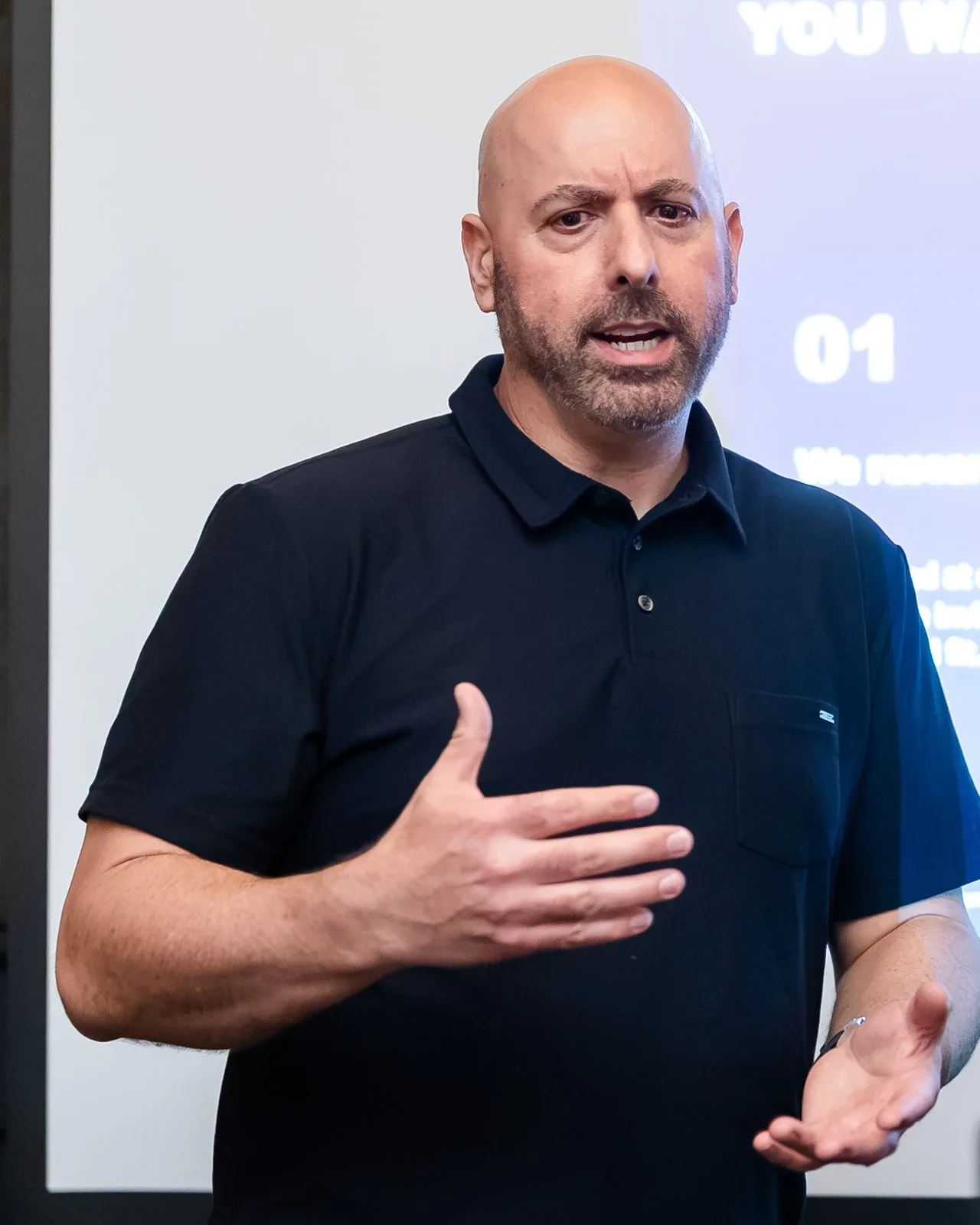
David can speak on this topic
A keynote talk based on this chapter
Price the Result, Not the Hours is also a keynote talk David gives. Audiences leave knowing how to replace proposals with service agreements and how to talk about price with calm and clarity.
Every chapter of The 45 Day Consultant Field Guide is also a keynote talk. David gives these talks to companies, associations, conferences and leadership teams.
David also gives a related keynote, Consulting Success: How to Start and Grow a Consulting Business, built for solo and boutique consultants, coaches and professionals who want to build a brand, attract clients and grow revenue. See his keynote programs (opens in a new tab)
A real result
How this idea worked for a client
Two Orangetheory Fitness studios, in Colma/Daly City and Pinole, went from bare dirt to launch. The scope was clear from the start: franchise agreement, site selection, build-out, hiring and training.
 Fitness franchiseTwo studios opened
Two Orangetheory Fitness studios, in Colma/Daly City and Pinole, taken from bare dirt to launch: franchise agreement, site selection, build-out, hiring and training.
Read the case studyTestimonials
What our clients say
“Right away things started to happen. We have managed to fill up our seminar rooms again, he has found us great new staff, and business is booming. More than a marketing consultant, he is also a business confidant […]”

“David was very helpful with structuring online marketing for my business. He presented clear ideas and strategy that was totally relevant for my dental office. His innovative thinking helps me to think outside the box.”

“We worked with Piedmont Avenue Consulting to implement new sales processes and launch a successful customer loyalty program. As a result, we have dramatically increased revenues from catering events and ‘front of mind’ sales.”

How it works
How we work: call, assessment, plan.
Schedule a call
Tell us where the business is today and where you want it to be.
Assessment
We look at your numbers, marketing, team and operations.
90-day plan
Three to five initiatives with owners and dates, plus a 12-month marketing calendar.
Ongoing initiatives
We stay on as a long-term partner and keep the plan moving.
We start with an assessment, agree on the priorities that matter most, and define what success looks like, then build a 90-day plan for ongoing work.
On the blog
Articles that go deeper on this chapter
Keep reading
More chapters from the Field Guide




Questions
Questions owners ask
What is value-based pricing?
Value-based pricing means the price follows the result the client gets, not the hours spent at a desk. David Mitroff, Ph.D. took the idea from Alan Weiss and built on the idea in his own way: clients pay for what changes for them.
Why does Piedmont Avenue Consulting, Inc. use service agreements instead of proposals?
A proposal is a guess written before a real conversation. Piedmont Avenue Consulting, Inc. talks with the owner first, clarifies the goals, and then writes a service agreement that both sides helped build.
What goes into a service agreement?
At Piedmont Avenue Consulting, Inc., a service agreement covers the work together, the expectations on both sides, meeting rhythm and communication, deliverables and timelines, what is not included, and how payment will work.
What is a master service agreement?
A master service agreement sets the main terms one time: payment, ownership, confidentiality, liability and how either side ends the relationship. David Mitroff, Ph.D. then adds each new project as a short scope of work under that agreement.
What should an owner do when a client asks for more work?
Open a new conversation instead of absorbing the change in silence. David Mitroff, Ph.D. suggests saying that the request is outside the current scope, then offering to write a new scope of work for the request.
What if a caller only asks how much?
David Mitroff, Ph.D. waits to talk about money until the conversation makes sense, or until the caller asks three times. Then he gives a very wide range and asks for the chance to ask his questions first.
How does working with Piedmont Avenue Consulting, Inc. start?
Working with Piedmont Avenue Consulting, Inc. starts with a call, then a paid assessment, then a 90-day plan with three to five initiatives and a twelve-month marketing calendar. In the first 90 days, we complete an assessment, agree on priorities with the client and define what success looks like. Read more about our approach.
Work with us
Schedule a call about your pricing
Every engagement starts with an assessment and a shared definition of success. We start with an initial consultation and a paid assessment, then build a ninety-day plan and a twelve-month marketing calendar.
One conversation and a clear next step.