
The book
The 45 Day Consultant Field Guide
Think like an owner. Work like a consultant. Be the expert they call first. A short, practical book by David Mitroff, Ph.D. for anyone people already come to for advice.
Front and back
For readers of the Field Guide
If the book sent you here, you are in the right place. This page has the six week plan, the Top 20 list, the charts from the book and a way to talk with David. If you have not read it yet, this is what it is about.
 (opens in a new tab)
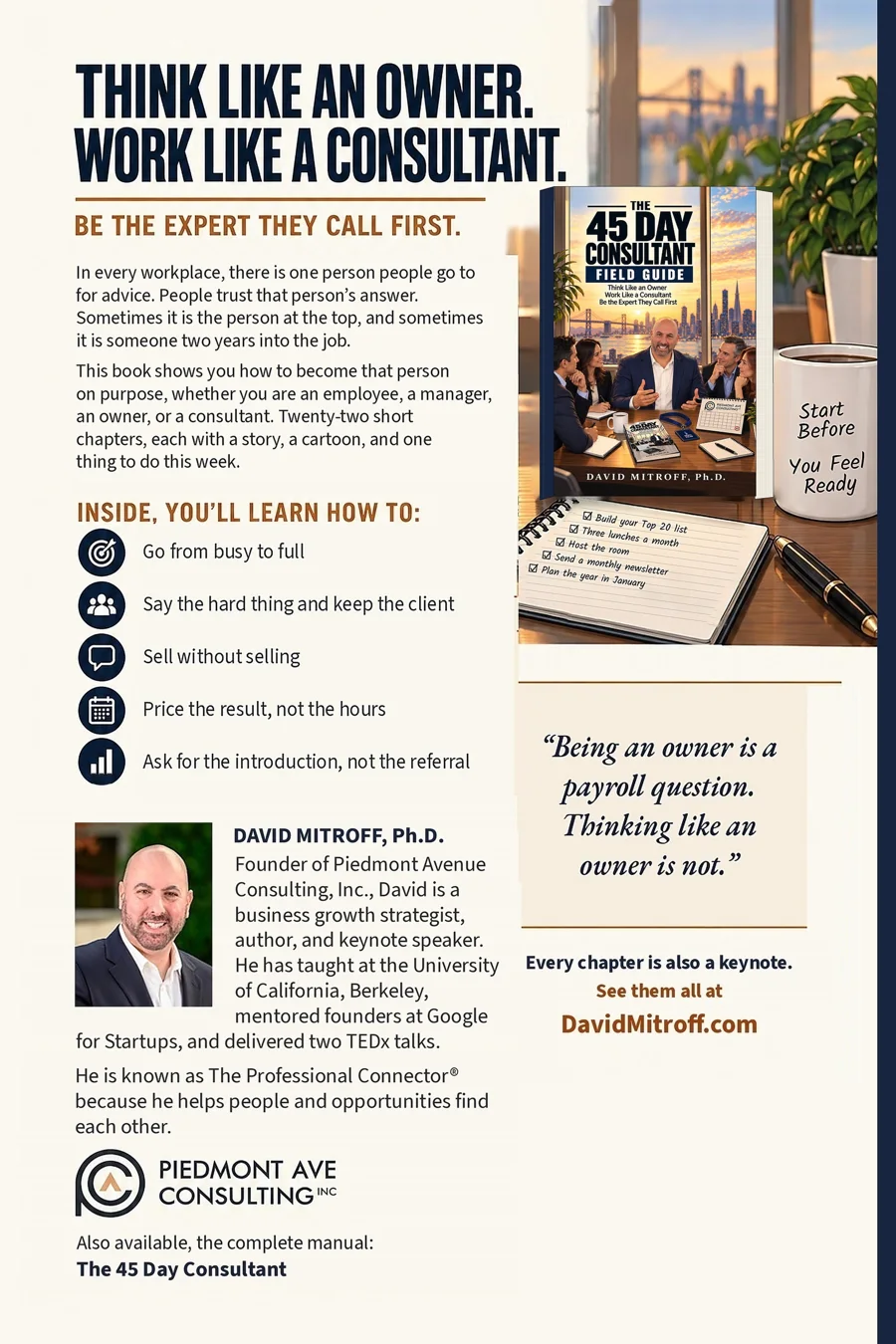
From the back cover
Think like an owner. Work like a consultant. Be the expert they call first.
In every workplace, there is one person people go to for advice. People trust that person’s answer. Sometimes it is the person at the top, and sometimes it is someone two years into the job.
This book shows you how to become that person on purpose, whether you are an employee, a manager, an owner, or a consultant. Twenty two short chapters, each with a story, a cartoon, and one thing to do this week.
Inside, you’ll learn how to
- Go from busy to full
- Say the hard thing and keep the client
- Sell without selling
- Price the result, not the hours
- Ask for the introduction, not the referral
“Being an owner is a payroll question. Thinking like an owner is not.”
What the book gives you
What you will walk away with
The Field Guide is built to be used, not just read. Here is what it promises, and where each part lives.
The six week plan
One job a week for six weeks, laid out below. Thirty to sixty minutes a day is enough.
Twenty two short chapters
Each chapter stands on its own, with a true story and a short list of things to put to work this week.
A twelve month marketing calendar
The tool David builds for every client, so nothing that happens every year arrives as a surprise.
Your Top 20 list
Twenty people, three conversations a month. The simplest way David knows to grow a business, or to grow inside one.
Better client conversations
How to run the first meeting, say the hard thing and keep the client, and sell without selling.
Pricing that fits the value
How to price the result instead of the hours, and how to ask for the introduction instead of the referral.
“People are already coming to you for advice. … That is where consulting begins.”
Who it is for
Three ways to use the book
Doing this work and owning a company are two different decisions. Nothing in the book asks you to leave a job, and nothing in it stops you.
If you already consult
You have your own consulting company, by yourself or with partners. These forty-five days make it run better.
If you want to start
You want your own consulting business. These forty-five days are how you start it.
If you are staying put
You like the job you have. These forty-five days help you keep learning, do a better job and bring more value to your company.
“These are not three different careers. They are three ways of becoming more effective in the career, company, profession, or business you already have.”
The six week plan
The 45-day plan week by week
Each week has one job, and each one builds on the week before it. This is the plan from the end of the book, ready to print.
Week one: Foundation and mindset
Decide what you do and who you do it for, and get a website live.
Week two: Visibility and credibility
Make yourself findable and give people a reason to believe you.
Week three: Offer and outreach
Three core services, priced, with a clear next step, in front of twenty people.
Week four: Network and build authority
Your Top 20 list, real conversations, and a room of your own.
Week five: Grow and improve
Follow up, publish again, ask for reviews, look at the numbers.
Week six: Momentum and scaling
Hand something off, prove your results in writing, and plan what comes next.
“Thirty to sixty minutes a day is enough. The plan works because the steps are small and they compound, not because any single day is heroic.”
Your Top 20 list
The Top 20 list for staying in touch.
From chapter 16, Turning Relationships into Revenue. Four groups of five, and a column for the last time you spoke to each of them.
Potential referral partners
| Name | Last talked |
|---|---|
Industry influencers
| Name | Last talked |
|---|---|
Trusted advisors
| Name | Last talked |
|---|---|
Past clients who can refer others
| Name | Last talked |
|---|---|
Three lunches a month × twelve months = thirty-six strategic partner meetings a year
A chart from the conclusion
Seven forty-five-day cycles in one year
A year holds seven forty-five-day cycles, with a few weeks left for holidays and the unexpected. Finish one meaningful thing in each one.
“Seven, not seventy. People overestimate what they can start in a year and underestimate what finishing seven things does to it.”
Chapter 15
The 12-month marketing calendar
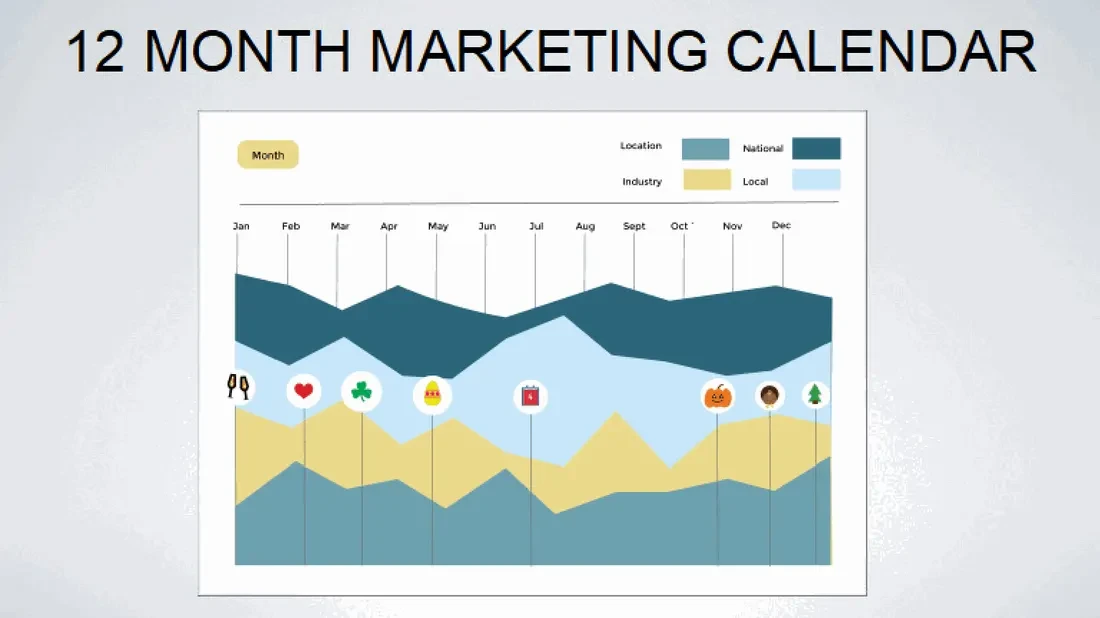
Every client David works with gets a twelve-month marketing calendar and a ninety-day plan to go with it. Industry dates, company launches, local events and personal plans all go on the same twelve months.
His test: walk into a craft store. What is on the front display is what you should be working on now. The clearance aisle in the back is what you were too late for.
“Nothing that happens every year is a surprise. It is a calendar entry you did not make.”
Chapter 16
Asking for introductions instead of referrals
A referral
- What it asks
- Higher stakes. They are vouching for you.
- How it feels
- Like putting their reputation on the line.
An introduction
- What it asks
- Lower pressure. “You two can talk.”
- How it feels
- Much easier to give, and just as effective.
Robin Dunbar found that people can keep about a hundred and fifty stable relationships, in layers: an inner circle of about five, then fifteen, then fifty, then the full hundred and fifty.
Your Top 20 list is the core, the people you speak with on a rhythm. Behind them sit others who rotate with your clients and your industry.
“Surround yourself with people who make you better, and help each other.”
A story from the book
Why forty-five days?
After a keynote in Pleasant Hill, California, two people told David he was funny enough to combine comedy and business. There is no license for stand-up comedy, so he added “Stand-Up Comic” to his LinkedIn profile.
A week later the city asked him back to speak in forty-five days, and promoted him as a business consultant, marketing expert and stand-up comic. After that talk, a woman asked how long he had been a stand-up comic.
“I said, ‘Forty-five days.’”
The idea is not that forty-five days makes you an expert. It is that you start.

From the TEDx talk and the book
When are you an expert?
It is the question in the title of one of David’s TEDx talks. The book gives four answers. Any one of them is a start.
- When you say you are.
- When other people say you are.
- When somebody pays you to do it.
- When you have been trained to do it.
Inside the book
Four parts, twenty two chapters
Every chapter has its own page in the Business Growth Guide, with a quote from the chapter, the idea in plain English and how to use it this week.
Part One: Think Like an Owner
- Chapter 1: Think Like an Owner, Whether or Not You Are OneOwnership is written on the paperwork. Owner thinking is a choice anyone can make, from the front desk to the corner office.
- Chapter 2: Revenue Is What People SeeStart with the money already leaving the business. Then look at price, profit, cash and the customer who comes back.
- Chapter 3: Busy Is Reacting, Full Is ChoosingBusy is the day that happens to you. Full is the day you chose on purpose, with work that has a reason to be there.
Part Two: Work Like a Consultant
- Chapter 4: You Are Already ConsultingIf people ask for your advice and trust your judgment, you are already consulting. The title usually shows up after the work.
- Chapter 5: Advise Like It’s Your BusinessGood advice fits the business in front of you, not the last one you saw. David Mitroff, Ph.D. learned that twice in one afternoon.
- Chapter 6: The Psychology Behind ConnectingWhat does a five-day workshop in Las Vegas have to do with winning clients? Quite a lot, as David Mitroff, Ph.D. found out.
- Chapter 7: Selling Without SellingA receptionist who turned away every salesperson still welcomed David in. Here is why, and how to build the same kind of trust.
- Chapter 8: Hard Conversations That Keep ClientsNot every engagement works. Saying so early, clearly and kindly is a skill, and you can learn it.
- Chapter 9: Price the Result, Not the HoursClients do not buy your time. They buy what changes for them. This page compares two ways to agree on work and shows which one holds.
- Chapter 10: Strategies for Measurable ResultsYou do not need a degree in statistics. You need a few numbers you understand, a look at them every month, and one direct question for your clients.
- Chapter 11: Trust Is the ProductOne question, asked at the right time, can matter more than every project on the invoice. These are the stories behind that idea.
Part Three: Be the Expert They Call First
- Chapter 12: When Are You Good Enough to Become an Industry Expert?Most people become experts near the end of long careers. David asked a different question: what does an expert look like without the wait?
- Chapter 13: Make Your Name Mean SomethingYour name is the first thing people repeat about you. Here is how David Mitroff, Ph.D. chose his, and how three clear services turn a name into a brand.
- Chapter 14: How Leaders Create LuckPeople call some owners lucky. David Mitroff, Ph.D. sees something else: a clear goal, steady action, and relationships built long before anyone needed them.
- Chapter 15: Plan the Year, Then Work the PlanSt. Patrick’s Day is in March every year. Halloween is in October every year. So why do the same dates still catch so many owners off guard?
- Chapter 16: Turning Relationships into RevenueYour next client is often one introduction away. This page shows how David Mitroff, Ph.D. builds referral partners on purpose, three conversations at a time.
- Chapter 17: Stop Selling to EveryoneA clear market makes marketing easier, not smaller. The more specific you get, the easier clients are to attract.
Part Four: Taking It Further
- Chapter 18: The Why Behind LeadershipHiring someone is one job. Leading that person well is a second job, and very few people are ever taught how to do the second one.
- Chapter 19: Scale Beyond YourselfGrowth means more work. Scaling means more work without more of you, because a system, a person or a product carries the load.
- Chapter 20: What AI Cannot SeeArtificial intelligence is a strong tool for any owner. In this chapter, David Mitroff, Ph.D. explains why the tool still needs your judgment, your eyes and your relationships.
- Chapter 21: Start Before You Feel ReadyDavid Mitroff, Ph.D. did not quit his job and then hope. He kept working, stayed useful in conversations, and let his first clients find him.
- Chapter 22: Success on Your Own TermsWhat would you do with a Saturday if nobody could see? David Mitroff, Ph.D. uses that question to help owners build a business around the life they want.
Quotes from the book
Quotes from the book
“One person changing one small thing is how most real improvement happens.”
“A good book about work does not care whether you own the place.”
“Start today. Start now. Your forty-five days begin the moment you decide they have.”
 (opens in a new tab)
The complete edition
Want more? Read The 45 Day Consultant
The Field Guide is drawn from The 45 Day Consultant. The complete edition covers each topic in depth across thirty-two chapters, with more stories, frameworks and detail on pricing, marketing calendars, speaking, printed materials, ethics and working internationally.

Book David to speak
Talks and workshops based on the book
Every chapter of The 45 Day Consultant Field Guide is also a talk. David gives keynotes, workshops, training and leadership sessions built on the book to companies, associations, conferences and leadership teams, including his two TEDx talks.
Work with David
Get help applying the book
Some readers want help putting the ideas in place. Pick the one that fits and schedule a call.
Consulting
Piedmont Avenue Consulting, Inc. works alongside your team on growth, marketing and operations, starting with a ninety-day plan and a twelve-month marketing calendar.
Executive coaching
One-on-one coaching for owners, executives and managers who want to lead with more clarity, make better decisions and grow their teams.
Start or grow your consulting firm
People come to you for advice. David helps you turn that into a consulting business: what to offer, who to serve, how to price it and where the first clients come from.
Testimonials
What our clients say
“Right away things started to happen. We have managed to fill up our seminar rooms again, he has found us great new staff, and business is booming. More than a marketing consultant, he is also a business confidant […]”

“David was very helpful with structuring online marketing for my business. He presented clear ideas and strategy that was totally relevant for my dental office. His innovative thinking helps me to think outside the box.”

“We worked with Piedmont Avenue Consulting to implement new sales processes and launch a successful customer loyalty program. As a result, we have dramatically increased revenues from catering events and ‘front of mind’ sales.”

Questions
Questions owners ask
Who is The 45 Day Consultant Field Guide for?
Anyone people already come to for advice: employees, managers, business owners, professionals such as attorneys and architects, and consultants. You do not need to start a company to use it. The book shows three ways to use it: if you already consult, if you want to start, or if you are staying in the job you have.
What is the difference between the Field Guide and The 45 Day Consultant?
The Field Guide is the short version, twenty two chapters built to carry anywhere. The 45 Day Consultant is the complete edition, with thirty-two chapters and more detail on every topic. Both books are on Amazon; use the Buy on Amazon buttons on this page.
How much time does the six week plan take each day?
Half an hour to an hour a day is enough. Each week has one job, from foundation and mindset in week one to momentum and scaling in week six, and the plan works because the steps are small and they compound. You can also read the chapters in any order, since each one stands on its own.
What is the Top 20 list in the Field Guide?
Twenty people you speak with on a rhythm, in four groups of five: potential referral partners, industry influencers, trusted advisors and past clients who can refer others. Three lunches a month adds up to thirty-six strategic partner meetings a year. It is the simplest way David knows to grow a business, or to grow inside one.
Why ask for an introduction instead of a referral?
A referral asks someone to vouch for you and put their reputation on the line. An introduction only asks them to suggest that the two of you talk, so it is much easier to give and just as effective. Chapter 16, Turning Relationships into Revenue, covers it.
Can David speak to my team about the book?
Yes. Every chapter is also a talk, so a team session can focus on the chapter your people need most, from pricing the result instead of the hours to saying the hard thing and keeping the client. Use Book David to speak, or schedule a call to talk it through.
On the blog
Articles that go deeper on the Field Guide.
Want every topic from the full book? See The 45 Day Consultant guide, or read the 22 Field Guide chapter pages.
Work with us
Ready to put the book to work?
We start with an assessment, agree on the priorities that matter most, and define what success looks like, then build a 90-day plan for ongoing work. We start with an initial consultation and a paid assessment, then build a ninety-day plan and a twelve-month marketing calendar.
Talk with David about your business, your team or your next event.